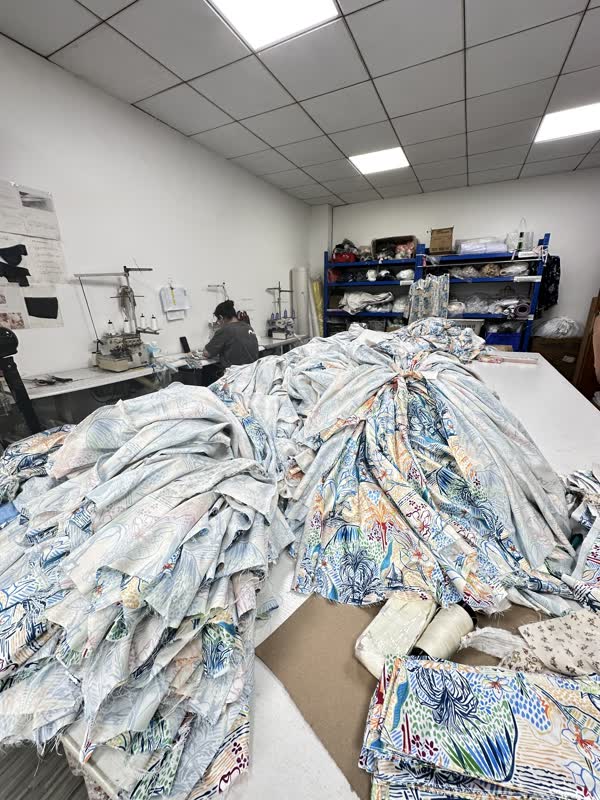
As a small batch clothing manufacturer we quote reorders from 30 pieces, and almost every one arrives with a change attached. Colour and size decide whether that reorder takes four weeks or nine.
Can you change colour on a reorder? Yes, until the fabric is dyed. After dyeing it is a new roll, a new dye lot and a new lab dip, and on viscose the old roll has no second life. Size is more forgiving: a size can be added or adjusted until the pattern is re-graded, usually up to the cutting date.
The windows are short because a reorder is short. Here is the calendar we work to, and the change we should have refused.
The four windows in a reorder
A reorder runs four to five weeks because the pattern, the fabric family and the line slot are already known. That leaves very little room between "we can change that" and "that cloth is dyed".
Days 0 to 5: nothing is booked. Colour, size, length, trims and labels all change for nothing.
Days 5 to 12: fabric is booked but not dyed. A colour change means the mill cancels the dye lot and runs a new lab dip, three to five days, with a fee of $40 to $80. It works only if the mill has not started the batch.
Days 12 to 20: cloth is dyed and in our store. Colour is closed. Length, trims, buttons and labels stay open, and a length change is a pattern amendment of one to two days.
After cutting: labels and hangtags only. Everything else is already in panels.
Why a colour change after dyeing costs more than the fabric
Sixty-two metres of ivory viscose at $3.20 is $198. That is the visible loss. The invisible one is that the roll cannot be re-dyed into cream without shifting shade and dropping hand, so it sits in our store until someone else wants ivory.
There is also the dye lot. Two lots of the same colour read about 1.2 Delta E apart, which is invisible on a hanger and obvious when a customer holds last season's dress next to this season's.
In 2022 a brand asked to move from ivory to cream nine days into a reorder. We said yes because the mill had not started. The mill had started. We ate $120 of the loss, the brand paid $78, and the reorder landed three weeks late.
Size changes are cheaper than colour changes
Adding a size to an existing grade is $60 to $100 and two to three days, plus 90 minutes on the marker. If the size already exists and you only want more of it, the cost is zero until the lay is planned.
Changing the grade rule is different. If size 14 sold out because it was cut too tight, that is a pattern amendment, a new mock-up and 10 to 14 days, at $150 to $220. The earlier you say it, the cheaper it is.
What we hold in stock to make reorders faster
We keep about 70 m of core fabric for a style we expect to repeat. It buys a week on every reorder and it removes one decision, because the colour is already made.
That is the trade. Held stock makes the reorder fast and the colour final. A brand that wants to test a new colour every season should not ask us to hold cloth.
It also changes what a reorder is for. A second run is usually about selling the shape again, not about testing a new palette. Brands that treat it as a palette test end up paying for a new dye lot on 30 pieces, which is the most expensive way to buy 62 m of cloth.
What a change does to the calendar
Every change costs three to five days, even when it costs no money. The lay has to be re-planned, the marker re-made, and the slot we held may go to another order while yours waits.
On a four-week reorder, two changes in the first ten days is the practical limit. Beyond that the order either ships late or loses an inspection, and losing the in-line inspection is the more expensive of the two.
The change we recommend most often is length. It moves no fabric order, needs no lab dip, and on a dress it is the single alteration that fixes the most returns. Colour is the one to decide before you send the purchase order, not after.
Written notice, and the five-day rule
Changes go by email with a date and a version number. A message that says "can we do cream instead" is a question, not an instruction, and nobody on the floor will act on it.
We confirm within one working day and state which window the change falls into. If the answer is no, it comes with the reason and the cost of the alternative.
Where we said yes too late
The 2022 ivory run is the one we use in training. The request arrived inside what we thought was the safe window, and we approved it on the sales side without checking the mill's batch schedule.
Now the mill's start date is a field on the order, not a phone call. A production agent we are building, still in training, will flag changes that land after a dye batch has started. Until then a person checks it, twice a week.
If you are planning a second run, the small batch program page shows the four-to-five-week reorder route, our FAQ answers the timing questions, and the case studies include the ivory reorder.
Go deeper: why a second run costs less · how a lab dip gets approved · what 400 rolls do through a Guangzhou summer
Questions we get about this
Can I change the fabric itself on a reorder?
Only inside the first five days, and usually not. A different fabric means a new consumption figure, a new marker and often a new mock-up, which is most of what a reorder saves you.
Does a reorder always cost less than the first run?
Usually 15 to 20 per cent less, because the pattern, the grade and the sample are done. A change inside the run eats most of that saving.
Quick Take
Until the dye starts. After that a colour change is a new roll and a new lot, not an edit.
1.2 Delta E. What separates two lots of the same colour, and what a customer sees side by side.
Email with a date. Not a message. The floor acts on instructions, not questions.
About UP Fashion
UP Fashion is a Guangzhou garment manufacturer founded in 2016, run by a team with 20+ years of OEM experience in silk, viscose and embroidery. We quote from 30 pieces, show the rate we used, and inspect three times before shipping.





