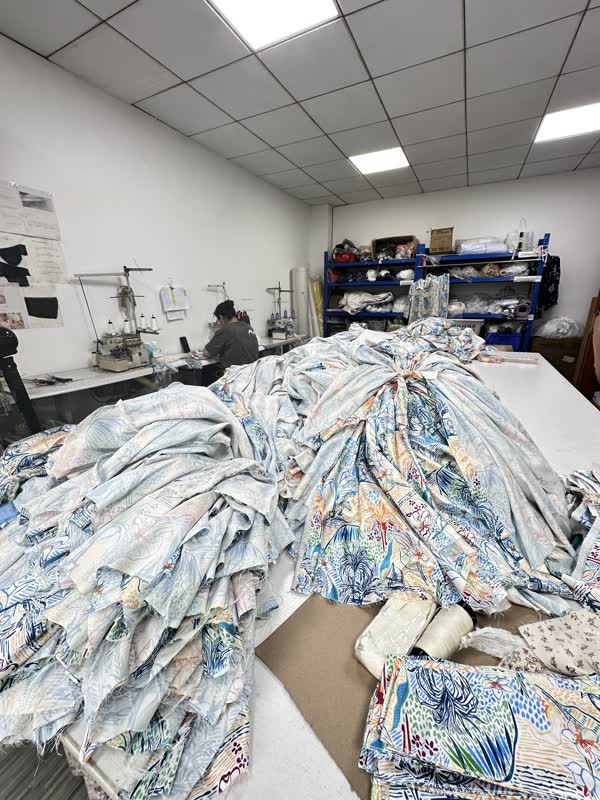
As a small batch clothing manufacturer, we get asked for thirty pieces in four colours almost every week, and the honest answer is that thirty pieces is a quantity, not a colour plan. One style in four colours is four small production problems wearing one order number. Here is what the minimum actually applies to, and how to split thirty pieces without multiplying your cost.
So how many colours fit in thirty pieces? With stock fabric, two or three, at ten to fifteen pieces each. With fabric dyed to order, one, because the dye minimum is usually 300 metres and thirty pieces need about 70. That single number decides most of the answer.
Per-style, per-colour and per-fabric are three different minimums
A factory quotes one minimum, and it is almost always the per-style figure, which for us is 30 pieces. That is the total across all colours and sizes, not a number for each colourway.
The per-colour minimum is a different thing and it is rarely written on a quote. It exists because each colour needs its own cutting lay, its own bundle tickets and its own quality record.
The per-fabric minimum is the third and the hardest. If two colours come from two different fabrics, the order is really two orders sharing one due date.
Stock fabric lets you split; dyed-to-order does not
Stock fabric is bought by the metre from a mill's existing range, so ten metres of ecru and twenty of black is a normal purchase. That is what makes two or three colours possible at thirty pieces.
Dyed-to-order fabric is made for you, and the mill will not start the machine below its minimum, which runs 300 metres on most viscose and 500 on prints. Thirty pieces of a lined dress need about 70 metres, so a single colour already leaves roughly 230 metres on the shelf.
Ask which type your fabric is before you plan colours. It is the difference between a two-colour capsule and a one-colour run.
What each extra colour actually costs
A lab dip costs $35 to $90 per colour, and most mills give two or three dips around the target. Three colours means three approval rounds, each of which takes two to four days.
Each colour also needs its own cutting lay and its own marker. One marker for a five-size nest is fine. Three colours of fifteen pieces each cannot share it, so you pay the laying time three times.
Trims behave differently. Woven labels, care labels and hangtags are ordered per design rather than per colour, so three colours do not triple the trim order. Only custom-coloured trims, like a dyed zipper tape, follow the fabric.
A worked example: 30 pieces, two colours, one style
Say a midi dress in viscose, thirty pieces, split 15 black and 15 ecru, both from stock fabric. Fabric is 2.1 metres per piece plus eight per cent for the marker, so about 34 metres per colour.
Stock viscose at $4.20 a metre makes the fabric $143 per colour. Two lab dips at $60 each add $120, and the second marker adds around $60 of laying time. The extra colour lands at roughly $180 on a $2,160 order.
Six per cent for a second colourway is a fair trade if it doubles the ways a customer can buy the dress. Four colours at that rate is not a capsule, it is a wholesale range.
The 2021 order with four colours and eight pieces each
In 2021 a client asked for four colours, eight pieces each. We took it because the total was thirty-two pieces and the fabric was stock. What we did not price properly was the cutting room.
Four colours meant four lays, four sets of bundle tickets and four quality records for a run that sewed in a day. The laying and ticketing took two extra days and cost us about $310 that we had not quoted.
We finished the order and lost money on it. Since then a third colour gets its own line on the quote, so the client can see what it costs and decide whether it is worth it.
How to plan colours at thirty pieces
Two colours, fifteen pieces each, on stock fabric, is the sweet spot. Three colours works if you accept eight to ten pieces each and the fabric is stock. Four or more only makes sense if you are planning a reorder before the first run ships.
If the fabric must be dyed to order, plan one colour for the first run and add a second on the reorder, when the dye minimum is already paid and the pattern is proven.
One more option is worth knowing. A single colour in two finishes, such as a matte and a satin version of the same base, reads as two styles on a rail and stays inside one dye minimum.
Where colour planning sits in the order
Colour count affects fabric buying, cutting and pricing, which is why it belongs in the first conversation. Our small batch production page sets out what we run at what size, the case studies page shows completed runs, the FAQ page answers MOQ and colour questions, and the production process page maps where fabric approval sits in the schedule.
Our Fashion Pains Solver tool, still in training, will let a brand test colour and minimum combinations before they ever email us. Until it is online, a two-line message about colour count and fabric type gets you the same answer.
Go deeper: how a small brand buys 100 metres · lab dips and why your navy is not our navy · what thirty pieces can and cannot do
Questions we get about this
Can I get 30 pieces in three colours?
Yes, if the fabric is stock. Plan eight to ten pieces per colour and expect an extra laying cost of roughly $60 per colour on top of the lab dips.
Does a second colour double my fabric minimum?
Only on dyed-to-order fabric. On stock fabric you buy by the metre, so 34 metres of black and 34 of ecru is an ordinary purchase.
Quick Take
Thirty pieces is a per-style total, not a per-colour number. Read the minimum that way.
Stock fabric allows two or three colours. Dyed-to-order usually means one, because the mill minimum is 300 metres.
Price a third colour on its own line. It adds about $180, mostly in laying time and lab dips.
About UP Fashion
UP Fashion is a Guangzhou garment manufacturer founded in 2016, run by a team with 20+ years of OEM experience in silk, viscose and embroidery. We quote from 30 pieces, show the rate we used, and inspect three times before shipping.





