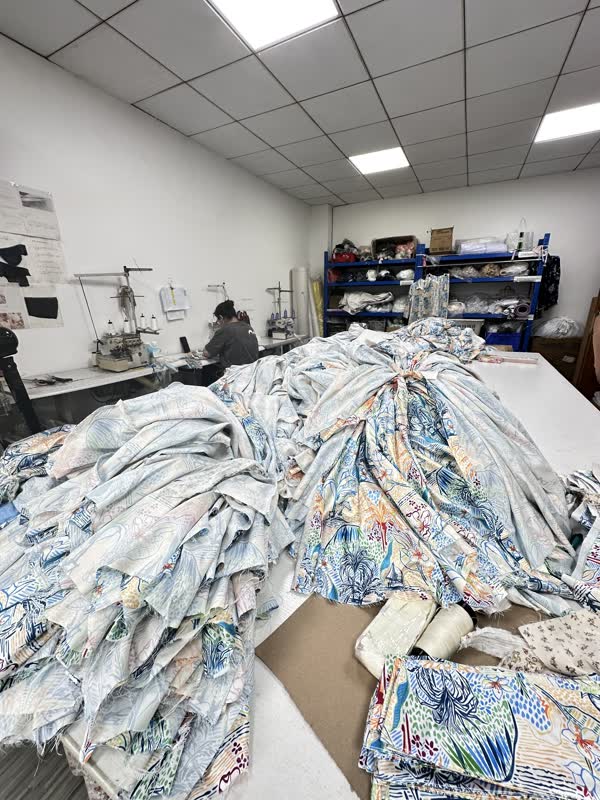
A small batch clothing manufacturer holds your fabric for four to six weeks before a blade touches it, and in Guangzhou that means holding it through 34 degrees and 85 per cent humidity. Storage is not a warehouse problem. It decides whether the cloth that reaches the cutting table is the cloth you approved.
The question we get most often is whether fabric can be damaged before cutting. It can, and the damage is rarely visible on the roll. Mildew starts on an inner fold, fading shows only on the outer layer, and a roll stored upright for a month goes out of round and skews the moment it is spread.
How to store fabric rolls without flat spots
Rolls lie horizontal here, on three-level racks, four to a bay, 12 bays. Nothing stands on end. A 1.5 metre roll left upright for three weeks goes oval by 8 to 12 millimetres at the core, and an oval roll feeds unevenly through the spreader.
Four hundred rolls is about 6,200 metres, which at 30 pieces a style is close to three seasons of work. That is why the store is a room with a door and a lock, not a corner behind the cutting table.
Weight is the quieter problem. A 30 kilogram roll resting on a pallet for two months takes a set along its bottom third, and that flat section will not lie flat on the table however long you relax it. We rotate rack positions every three weeks.
Nothing sits on the floor. Pallets hold a 12 centimetre clearance, which sounds excessive until the drains back up.
What humidity does to viscose, linen and polyester
Viscose takes up about 13 per cent of its weight in water at 65 per cent relative humidity, linen about 12, cotton 8.5, polyester under 1. That gap is why a store that feels fine to you is not fine for the cloth.
We hold 20 to 26 degrees and 55 to 65 per cent relative humidity, with two 50 litre dehumidifiers running from May to October. Above 70 per cent for ten days, mildew risk climbs fast, and viscose shows it first.
Below 45 per cent the opposite happens. Cloth dries out, turns brittle at the fold, and static makes a satin roll cling to itself during spreading.
Linen is the harder case. It drinks moisture and then dries stiff, so a linen roll that sits through a wet week needs a day back at 55 per cent before it will spread without cracking along the fold.
Why the roll label matters more than the shelf
Every roll carries four things: lot number, metres received, date received, and the style it was bought for. Without the lot number you cannot match the two rolls that must be cut together, and a shade difference between panels is the defect a customer sees first.
First in, first out is the rule, and it is harder than it sounds when a new delivery looks tidier than the old stack. We write the received date on the end of the roll in marker pen, not in a spreadsheet nobody opens in the store.
What a Guangzhou summer actually did to us
In June 2019 we stored 60 rolls of viscose on the floor because the racks were full. A typhoon pushed three centimetres of water across the store overnight, and 18 rolls were rejected at inspection the next morning.
The loss was $2,100 in cloth plus four days of schedule. What changed: pallets under everything, a $60 water alarm at the drain, and a rule that the racks are never allowed to be full enough to justify the floor.
We also learned that water damage does not look like damage. The outer layer dries, the core stays damp, and the mildew appears nine days later on a roll that seemed fine.
Storage time is not free, and it is not unlimited
We hold cloth for 30 days at no charge, then $0.18 per metre per month. That is not a penalty. It is the cost of the space, the dehumidifier and the person who checks the store twice a week.
Cloth held past three months is not ruined, but it needs re-inspection before cutting, and re-inspection costs a day. If your launch is eight months out, the honest advice is to buy later rather than store longer.
Rolls that arrive damp, and the check we run first
Cloth shipped by sea can arrive with condensation inside the bag, especially if it was packed warm. We open every roll within 24 hours of arrival and run a hand down the inner fold, because that is where damp sits longest.
A damp roll goes straight to the conditioning room at 55 per cent, not onto a rack. Drying it slowly takes two days; drying it in the sun takes an afternoon and ruins the hand of the cloth.
Two deliveries in the last year arrived with a wet outer layer from a truck that had no cover. Both were fine after 48 hours of slow drying, and both would have mildewed if we had stacked them.
What to ask before you ship fabric to a factory
Four questions to ask. Where does it sit, on what, and at what humidity, plus who checks it, and how often. Ask what happens if a roll is damaged in store, and what the storage charge is after the first month.
A factory that answers all four without leaving the room has a store. One that answers "in our warehouse, it is fine" does not.
If you are supplying your own cloth, our small batch program covers the handover, the case studies show a roll-level rejection, and the FAQ covers storage charges.
Go deeper: where your fabric order goes wrong · what 4-point inspection rejects · why cloth needs 48 hours before cutting
Questions we get about this
Can I store fabric at the factory for next season?
Up to 90 days at the rate above. Past that we re-inspect before cutting, and some viscose will have taken a set at the fold that no amount of relaxing removes.
Should I send fabric in one delivery or several?
One delivery, one lot. Split deliveries arrive with different dye lots and you will be matching panels by eye on the cutting table.
Quick Take
20 to 26 degrees, 55 to 65 per cent humidity. Above 70 per cent for ten days, viscose mildews on the inner fold where nobody looks.
Rolls lie horizontal, never on end. Three weeks upright puts 8 to 12 millimetres of oval into a 1.5 metre roll.
Ask the storage rate after 30 days. Ours is $0.18 per metre per month, and the answer tells you whether there is a store at all.
About UP Fashion
UP Fashion is a Guangzhou garment manufacturer founded in 2016, run by a team with 20+ years of OEM experience in silk, viscose and embroidery. We quote from 30 pieces, show the rate we used, and inspect three times before shipping.





