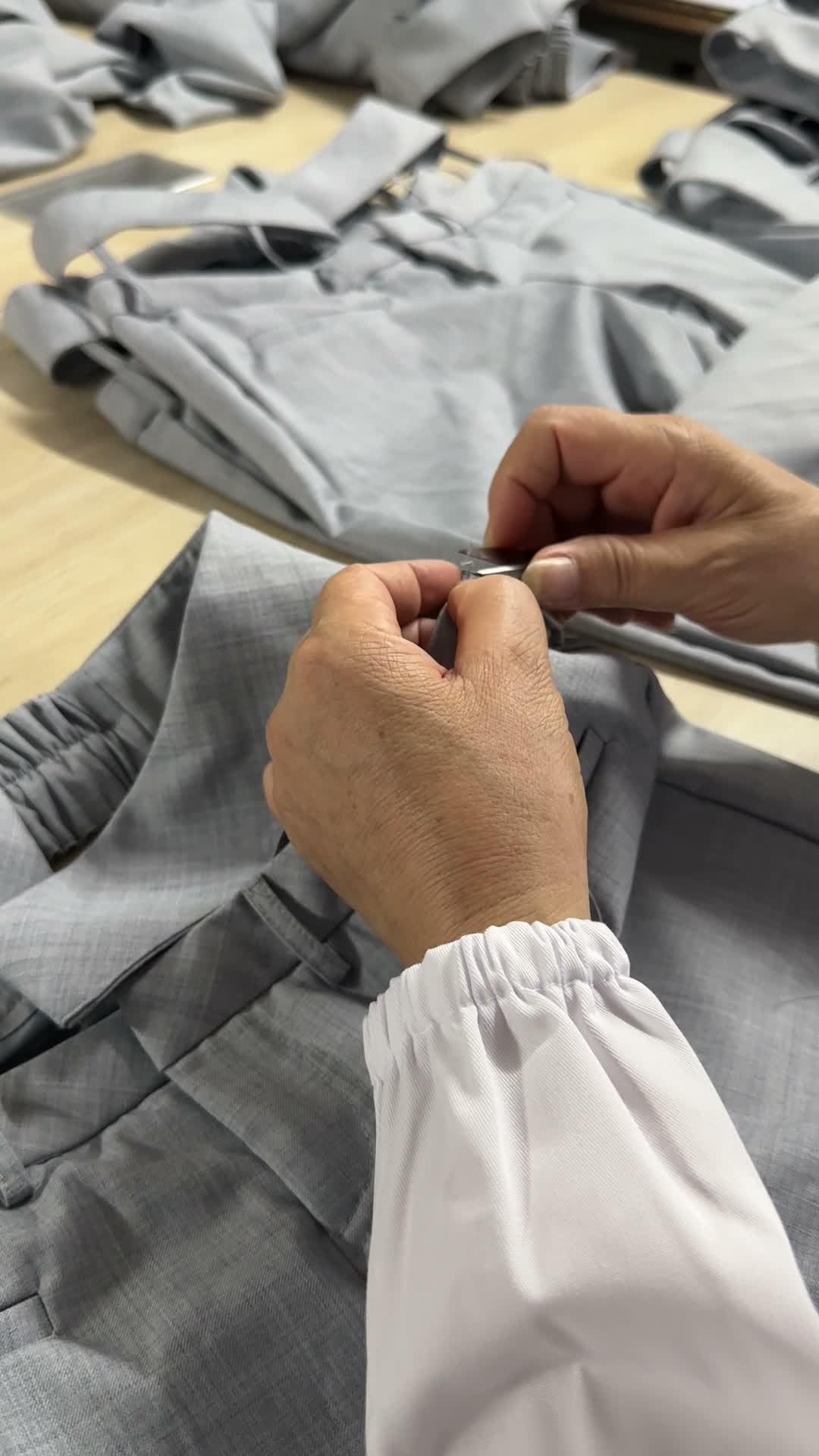
A high end clothing manufacturer should be able to hand over payroll, overtime and insurance records on request. Most cannot produce them in under a week, and some cannot produce them at all. We know because we were one of the slow ones until 2019.
What documents can a buyer ask a factory for? Four, and none of them is a certificate. The business licence, a payroll summary, an overtime register, and the monthly social insurance payment record. A Sedex or BSCI report describes one day; these four are the machinery that runs every day.
What an overtime register looks like when it is real
A real register has a name, a date, a start time, an end time and a signature, per person, per day. Ours covers 42 sewers on three lines, on an eight-hour base day with a two-hour overtime cap across six days.
What we kept before that was tidier and useless: overtime logged per line, one number for fourteen people. It balanced, it proved nothing, and rebuilding two years of it for a 2022 audit took an administrator three weeks.
The test a buyer can apply in a minute: ask for March. A register that exists will be produced in an hour. A register that was written last week will arrive as a summary with no names.
Social insurance: the line between a factory and a workshop
Five insurances are paid monthly per worker against a declared wage base: pension, medical, unemployment, work injury and maternity. The employer share adds roughly a quarter on top of the wage, which is how a twelve-person workshop with no insurance quotes 8 to 12 per cent under us.
Ask for the payment record rather than the registration certificate. A certificate says the account exists. The monthly record says whether anyone was paid into it in March, and whether the headcount matches the payroll.
This is also the number that decides who can supply a stockist. A brand that signs a big retailer usually inherits an obligation to show its supply chain is insured and its hours are legal, and a factory that cannot show it becomes the reason a contract is not signed.
The 40-minute audit you can run from a laptop
Five checks. Does total payroll divided by headcount sit within 15 per cent of the local minimum wage plus overtime? Does the overtime register show a rest day in every seven?
Do the insurance payments cover the same headcount as the payroll? Does the licence scope say garment manufacturing rather than trading? And does the invoicing entity match the licence name exactly?
Hours come before wages in most audit frameworks. A 60-hour week is legal in peak season with the right approvals and illegal without them, and the register is the only place that distinction survives a year later.
A factory that fails the fourth check is a trading company with a workshop attached. That is not a scandal, and plenty of good sourcing happens that way. It becomes a problem only when it is discovered at the third order instead of the first conversation.
What a third-party audit costs and what it finds
A social audit runs $600 to $1,200 a man-day, and a two-day visit with travel from Shanghai or Hong Kong lands near $2,400. On a 30-piece order that is more than the goods, which is why almost nobody buys one at that size.
What it usually finds is paperwork rather than cruelty: a missing fire drill record, an expired first-aid certificate, a wage slip with no signature. All three are fixable in a month, and none of them is visible in a sample.
What we will not show you, and why
We will not send individual wage slips or ID numbers. Those belong to the workers, and a brand holding a spreadsheet of 42 people's pay is a data protection problem in Europe and a dignity problem everywhere.
What we do send is an aggregate: headcount, total payroll, total insurance paid, overtime hours by month, and the auditor's summary if there has been a third-party visit. If a compliance team needs more than that, they can come and read the file on site.
There is a version of this that factories do, which is to hand over a payroll file with the names stripped and the totals rounded. It passes a checkbox and teaches the buyer nothing. We would rather send the real aggregate and be asked a hard question.
Why a 30-piece order rarely gets audited
On a 30-piece first run nobody audits. The order is worth less than the audit, which runs $600 to $1,200 a man-day before travel.
That changes the moment a stockist or a marketplace asks for evidence before taking the brand on. The brand then needs documents from a factory it ordered 30 pieces from eight months earlier, and that is the wrong week to begin keeping records.
The practical answer is to ask at the quoting stage, when you have the most to gain and nothing to lose. A factory that answers in a day keeps records for its own reasons, and that is a better signal than a certificate with a logo on it.
Where our own file was thin
For years our worker file was a folder per person holding a contract and a copy of an ID. It had no training record and no proof of a fire drill, so a 2019 audit marked us down on two clauses we could not argue with.
We rebuilt it into five sections with a monthly tick, which took a month of one person's time. It has since won us two orders where the alternative factory was cheaper and had no file, and in both cases the buyer told us why.
None of this makes us an auditor and we do not sell compliance. What we can do is answer the four documents in a day, which is a low bar that a surprising number of factories still miss.
If you are choosing between factories, our FAQ lists what we need before quoting, and the high end production program page shows how the three stages are documented. The case studies include the audit we failed in 2019.
Go deeper: six things to verify before you trust a factory · five checks before the deposit · ten questions a factory asks before it quotes
Questions we get about this
Is a BSCI or Sedex certificate enough?
It is a snapshot with an expiry date, and it is better than nothing. Pair it with the four documents above, because a certificate can be bought through a consultant and a monthly insurance record cannot.
Will asking for payroll offend a factory?
Some will refuse and some will stall. A factory that refuses a payroll summary is telling you something useful before you have paid a deposit, which is the cheapest possible time to learn it.
Quick Take
Four documents, no certificates. Licence, payroll summary, overtime register, insurance record.
Ask for March. A real register arrives in an hour. A summary with no names was written last week.
One rest day in seven. If the register cannot show it, the hours are not legal.
About UP Fashion
UP Fashion is a Guangzhou garment manufacturer founded in 2016, run by a team with 20+ years of OEM experience in silk, viscose and embroidery. We quote from 30 pieces, show the rate we used, and inspect three times before shipping.





