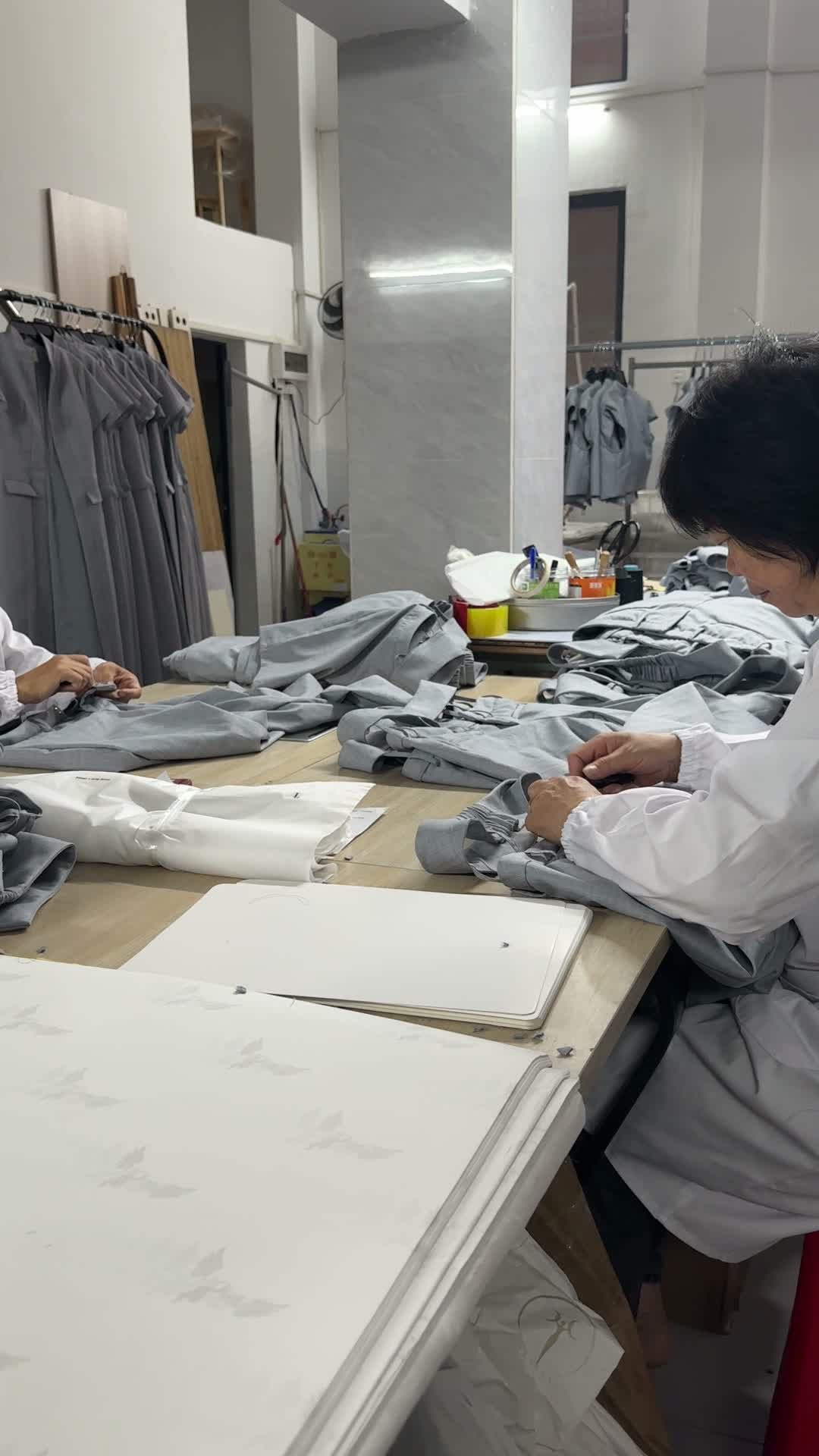
A cut and sew manufacturer in Guangzhou runs on a calendar that has nothing to do with your launch date, and August is the month where that hurts most.
Why is August bad? Every brand that wants stock on a shelf for northern autumn places its order in the same six weeks, and the sample rooms fill before the sewing lines do. An order placed in August comes back two to four weeks later than the identical order placed in May.
Here is the year as a factory actually sees it, and how to count backwards from a shelf date.
Chinese New Year factory closure: three weeks the calendar stops
Chinese New Year is the single biggest block in the year. Factories close for two to three weeks, and the dates move with the lunar calendar, landing anywhere from late January to late February.
The week after reopening is not a full week. Staff return in stages, and a line that normally runs 40 machines often has 28 running on day one.
Mills close earlier than factories and reopen later. Fabric ordered in the last week before the holiday will not be woven until the second week after it.
If you need stock in March, the fabric has to be on our floor by mid-January. That is the real deadline, not the holiday itself.
Golden Week and the October capacity crunch
The first week of October is a national holiday, and the week before it is the busiest of the year.
Brands that need stock for the November and December selling season all want to ship in September. Sample rooms are booked three weeks out and air freight rates rise 20 to 40%.
Golden Week itself is shorter than Chinese New Year, usually seven days plus travel either side. The capacity crunch around it lasts a month.
If your launch is spring, none of this touches you. If it is autumn, every decision you make in June and July is really an October decision.
August and the sample room: why samples queue before the line does
August is not a holiday month. It is the month before the rush, and that is why it is the worst time to start.
Sample rooms run at the front of every order. A mock-up round takes ten to fourteen days in a quiet month and three to four weeks in August, because every autumn order wants its sample approved in the same window.
The sewing line still has capacity. The sample room, the pattern maker and the fit technician do not, and those three are what a new style needs first.
The honest version we give clients: place the order in August if your shelf date is February. If it is October, you are already late and air freight is the only lever left.
Typhoon season in Guangdong and the summer buffer
Guangdong's typhoon season runs June to September. Most years it means two or three days of lost production, not a week.
The cost is not the lost days. It is the fabric. A container delayed by a port closure arrives wet or arrives late, and both cost more than the days.
We ask for sea shipments to carry moisture barrier film year-round, and we schedule deliveries with a seven-day buffer between June and September.
Small brands rarely lose a whole order to weather. They lose four to six days, and four to six days is enough to miss a buying appointment.
Working backwards from a shelf date to an order date
Take your shelf date and count back. Twelve weeks for a first run, five for a reorder, plus two if the fabric is dyed to order.
Then add the buffer: two weeks if the order lands between June and September, three weeks if it crosses Chinese New Year or Golden Week.
A spring drop that needs stock on 1 March in a dyed-to-order fabric: 1 March minus twelve weeks is 8 December, minus two for dyeing is 24 November, minus three for the holiday is 3 November. That is your order date.
Write it in the calendar as the order date, not the ship date. Ship dates are the number that makes brands late.
What to do when you are already late for the season
Three levers, in order of how much they hurt. Split the order and ship 40% by air for the launch. Simplify and drop the print or the custom trim that adds a supplier. Extend the drop two weeks and use the gap for pre-orders.
What does not work is asking a factory to compress. A twelve-week run is not a nine-week run with more effort. The mock-up rounds sit on the calendar, not on the effort.
In 2022 we accepted an August order with an October shelf date and told the client it would ship in the last week of October. It shipped on 26 October, the launch moved eleven days, and she spent the gap on a pre-order list that sold 40% of the run before it landed.
That is the honest version of a late order: not rescued, but recoverable.
Our cut and sew page sets out the four workstations and what you supply, and the FAQ page covers the timeline questions we get most. The case studies page lists delivered runs with their actual ship dates. Our production process page maps the two mock-up rounds and three inspections that sit between a deposit and a shipment. The Fashion Pains Solver we are bringing online will read a shelf date and count back through the holidays for you.
Go deeper: a 50-piece order, week by week: deposit to delivery · why your clothing order is always late · mock-up rounds: why yours keep coming back wrong
Questions we get about this
How long do Chinese factories close for Chinese New Year?
Two to three weeks, and the dates move with the lunar calendar. Mills close earlier and reopen later, and the first week back runs at about 70% of normal line capacity while staff return in stages.
When should I place an order for spring stock?
Count back twelve weeks from the shelf date for a first run, plus two weeks if the fabric is dyed to order, plus three if the window crosses Chinese New Year or Golden Week. For 1 March stock in a dyed fabric that lands on about 3 November.
Quick Take
August is the sample room crunch, not the line. Mock-up rounds go from ten to fourteen days up to three to four weeks because every autumn order wants approval at once.
Chinese New Year takes three weeks, Golden Week takes one. The crunch around Golden Week lasts a month and lifts air freight rates 20 to 40%.
Book the order date, not the ship date. Twelve weeks plus two for dyeing plus three for a holiday window. That is the number that keeps a launch on time.
About UP Fashion
UP Fashion is a Guangzhou garment manufacturer founded in 2016, run by a team with 20+ years of OEM experience in silk, viscose and embroidery. We quote orders from 30 pieces, plan around the holiday calendar before we accept a date, and inspect three times before shipping.





