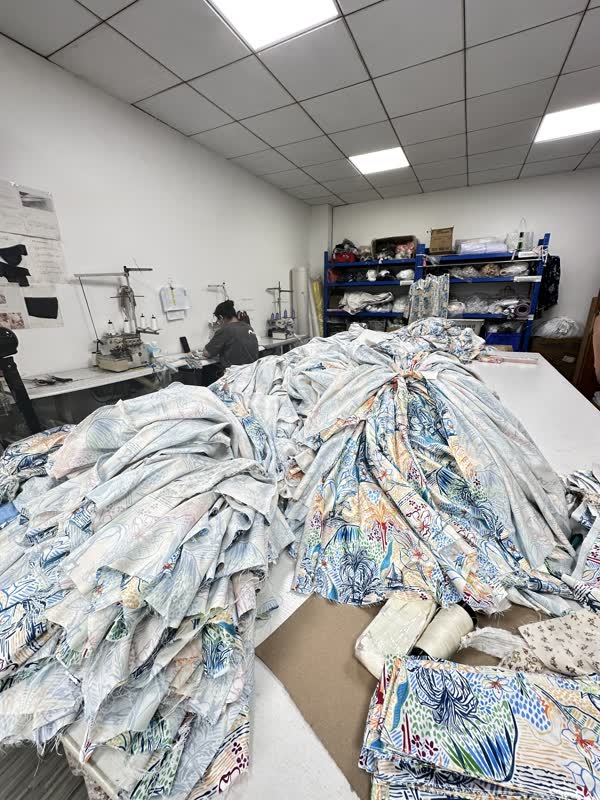
A private label clothing manufacturer will tell you the fabric minimum before you order. Almost none will tell you what happens to the fabric you pay for and never cut.
So where does the leftover go? If we bought it, it stays with us and we can hold it for your reorder or send it to you at your cost. If you bought it, it is yours the moment it lands, and you decide. The number that matters is how much you will actually have left.
On a thirty-piece dress run you buy about 100 to 120 metres and cut 85 to 95 of them. The rest is marker waste, end-of-roll and spares. Here is how we plan for it.
How much fabric is actually left over
On a small run, marker waste runs 8 to 12 per cent. At high volume it drops to 4 to 6 per cent, because a marker can nest more sizes across a wider lay.
On 120 metres, that waste is 10 to 14 metres. Add the end of the roll, which mills often ship three to five per cent over, and a small order can leave 15 metres on the shelf.
Why small runs waste more
A thirty-piece order has fewer sizes to nest, so the marker cannot share fabric between a size 8 and a size 16. The gaps between pieces are wider, and wider gaps are wasted cloth.
Ask the factory for the expected leftover in metres, not as a percentage. A number in metres is something you can plan a second style around; a percentage is a number you cannot act on.
Marker waste: the 8 to 12 per cent nobody quotes
Most quotes show a fabric cost and stop. The marker percentage is where a small run quietly costs more than a large one, and it is worth asking for the number.
If a factory tells you the marker efficiency, you can sanity-check the fabric line yourself. If it cannot, it may not be measuring it.
Who owns the leftover, and who stores it
Whoever paid for the fabric owns it. If you supplied the cloth, the leftover is yours and we will pack it back with the shipment if you ask, at your freight cost.
If we sourced it, we hold it. For orders with a likely reorder we store the leftover free for twelve months, tagged with the style, colour and dye lot. After that we either ship it or, with your written go-ahead, recycle it.
Ask this before the deposit
Ask where your leftover will be stored, for how long, and at what cost. A factory that will not answer that is a factory that will not remember your dye lot next season.
Three ways to use leftover instead of shelving it
The cheapest fabric you will ever buy is the fabric already in the building. Here is how we help clients use it.
- Cut a second style from the same roll in the same colour, so two looks share one fabric line.
- Run a small add-on style, like a simple skirt or top, to round out a capsule.
- Save it for next season's sample rounds, so mock-ups do not eat new cloth.
All three only work if the leftover is real, matching, single dye lot fabric. Mixed offcuts are not useful for production, only for testing.
How to plan an order so you waste less
Waste is not fixed. Three habits cut the leftover on a small run before a single metre is bought.
- Nest five sizes in one marker instead of splitting by colour, so the gaps close.
- Buy one colour across two styles, so the roll is used down to the last usable length.
- Add a simple second style that can absorb the offcuts of the first.
None of these need a bigger order. They need the plan set before the fabric is cut, because once the lay is on the table the leftover is already decided.
What dead stock really costs
Dead stock is not free just because it is already paid for. It is capital sitting on a shelf, and it is a risk that the next dye lot will not match it.
In 2022 a client bought 300 metres of dyed-to-order fabric for a 40-piece run. About 240 metres stayed on our rack for fourteen months. When they reordered, the new dye lot came in 1.5 Delta E away from the old one, and the two runs did not match side by side on the rail. They sold the old pieces as a separate drop.
The two costs people forget
Storage and dye-lot drift. Neither shows on the invoice, and both show up eighteen months later when you try to reorder.
When to donate, and when to keep
Keep leftover that matches a style you may reorder. Donate or recycle the rest, because a shelf of unmatched offcuts is a cost with no upside.
Guangzhou has textile recyclers who respin clean cotton and viscose. We will send dead stock there with your written go-ahead, and we do not sell your fabric to anyone.
What we put in writing
Every quote from us states the estimated leftover, who owns it, and the storage terms, so the question never comes up at shipment. Our private label program covers fabric sourcing and storage as separate lines.
The FAQ page answers fabric and minimum questions, the case studies page lists runs by fabric, and the production process page shows where fabric is received and stored.
Go deeper: buy your own fabric or let the factory buy it · made to order versus stock, and what eats your cash · why a second run costs 18 per cent less
Questions we get about this
Can you match a dye lot from a previous order?
We can try, but no mill guarantees a perfect match across two dye lots. We ask for the old lot number, order the closest available, and tell you the Delta E before you commit.
Will you send leftover fabric back with the finished garments?
Yes, if you ask before packing. We roll and tag it, and it travels with the bulk shipment. Freight on the extra weight is yours, and it is usually small next to re-buying the fabric.
Quick Take
Expect 8 to 12 per cent waste on a small run. On 120 metres that is 10 to 14 metres gone at the marker before you count the end of the roll.
Whoever pays owns it. Decide before the deposit who stores the leftover, for how long, and at what cost.
Dead stock has two hidden costs. Storage and dye-lot drift, and both surface when you try to reorder.
About UP Fashion
UP Fashion is a Guangzhou garment manufacturer founded in 2016, run by a team with 20+ years of OEM experience in silk, viscose and embroidery. We quote orders from 30 pieces, state our storage terms, and inspect three times before shipping.





