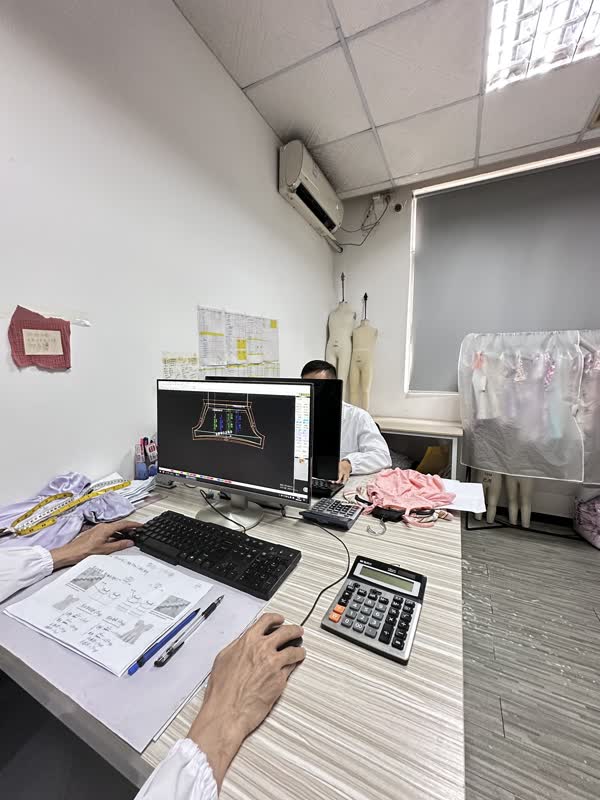
A small batch clothing manufacturer uses the word custom differently from a trading company. Custom should mean your pattern, your fit, your cloth and your labels, not a stock style with your tag sewn in.
What does custom actually include at 30 pieces? Your own pattern and grade, a fit model fitted over two mock-up rounds, your choice of cloth from a stock range, and your own neck label, care label and hangtag. What it does not include at 30 pieces is a dyed-to-order cloth or custom hardware, because both carry minimums ten times your run.
Here is where the line sits, and what the custom part costs.
Custom pattern and grade: the line between custom and stock
A new pattern built from your reference images and your fit model's measurements runs $120 to $260, and we credit it against the bulk order once it is placed. Adjusting one of our existing blocks to your measurements runs $40 to $90.
The grade rule is the part people forget. A pattern is one size; a grade is the rule that moves bust, waist and hip between sizes, and it has to be set to your range rather than borrowed from a standard run.
Three questions separate a custom supplier from a relabelled one. What base size is my pattern drafted on? How many pattern pieces does the style have?
Then ask what the hip grade step is. A supplier selling stock with your label cannot answer that one, because the rule was written for a different block on a different body.
Pattern storage matters more than it sounds. We keep the block, the graded nest and the fit comments in one folder against the style number, so a reorder is a cutting ticket rather than a project. A brand that reorders twice a year gets its third run at the lowest price of the three without changing a single spec.
Custom patterns for designer labels ordering small quantities
For a designer, the pattern is the product. That is why we draft on your measurements and keep the block on file with the style number, so a reorder six months later starts from the same pattern instead of from a fresh interpretation.
It also means your first order carries the pattern cost and your second does not. On a 30-piece run a $180 pattern is $6 a garment. On the reorder it is zero, and the same style gets cheaper without anything about the sewing changing.
What we will not do is pretend a five-style first collection is cheap. Five styles is five patterns, five grades and five sets of mock-ups, and that is the number that decides a first order size rather than the piece price.
Custom cloth: why a stock fabric is not a downgrade
We hold a shade range in viscose, polyester, linen, cotton-linen, satin, rayon and TR suiting, sold by the metre from stock with no minimum. A 30-piece midi dress needs about 57 metres, and 57 metres off a stock roll is an ordinary order.
Dyed to order starts at 300 metres per colour at most mills. Buying that minimum for a 30-piece run leaves about 240 metres in your storeroom, which is deadstock with your name on the invoice.
What a custom shade buys you is a colour nobody else is selling this season. If that is the point of the collection, buy it once across two styles so the 300 metres is spread over 60 pieces instead of 30.
Custom labels, care labels and packaging at 30 pieces
Neck label, care label, hangtag and bag can all carry your brand on a 30-piece order. The artwork is what costs, not the quantity, so the design fee is the same at 30 as at 300.
Care label content has to match where you sell: fibre composition as a percentage, country of origin, and the language of the country of sale. For the EU that means the language of the member state, not English by default.
Keep one hangtag design across the season. A second hangtag is a second plate charge and a second proof round for no selling benefit.
What custom work costs at 30 pieces
Here is the one-off side of a custom 30-piece order, in our own numbers. Pattern $180, grade $60, two mock-up rounds included, woven label loom charge $90, care label plate $40. About $370 before a metre of cloth is cut.
Divided by 30 that is $12.33 a garment. On the reorder it is zero, which is the honest reason a custom first run costs more than a relabelled stock order and why the gap closes from the second order.
So the question is not whether custom is worth $12 a piece. It is whether you are selling your own shape at $250 retail or somebody else's shape with your label in it.
What "custom" means when a brief is not custom at all
In 2018 we quoted a custom order from a client whose reference photos were a wholesaler's stock dress shot on a different model. We drafted a new pattern to the pictures, and it fitted nothing like the photo because the photo had never been the garment.
We now ask for the measurements of the reference garment, or the body it was worn on, before we call a brief custom. Two chest, waist and hip numbers plus a length save a pattern and a mock-up round.
The test takes ten minutes on your side. Ask for the flat measurements of the reference garment and compare them with the first mock-up when it arrives. If the two do not line up, the brief was never custom, whatever the invoice said.
We decline wool outerwear, knitwear and hand beading at any volume, and our cloth list stays inside viscose, polyester, linen, cotton-linen, satin, rayon and TR suiting.
Our small batch program page sets out quantities and minimums. The FAQ page answers the custom questions we get most, and the case studies page lists delivered orders with their quantities and fit outcomes attached. Our production process page maps the two mock-up rounds and the three inspections. The Fashion Pains Solver we are bringing online is being built to separate a custom brief from a stock one before a pattern is drawn.
Go deeper: starting a clothing brand: 30 pieces per style, from a factory · 50 pieces or 30? choosing your first order size · private label clothing for new brands: one style, 30 pieces
Questions we get about this
Is a custom pattern worth it for a 30-piece order?
At about $12 a piece on the first run, yes if the shape is yours to sell. The pattern is a one-off cost that does not repeat: on the second order the same style costs less with nothing changed in the sewing. A brand planning to sell one shape for several seasons gets the most out of it.
How long does a custom pattern take before bulk cutting?
Two to three days for a first draft, about a week for the first mock-up, and three to four days for the second once fit comments are back. From measurements to an approved pattern, plan on two to three weeks. Add a week if the fit model's numbers arrive late.
Quick Take
Custom means your pattern and your grade. $120 to $260 for a new pattern, $40 to $90 to adjust one of ours, credited against bulk. Ask what base size it is drafted on.
Stock cloth is not a downgrade. A 30-piece dress needs 57 metres. Dyed to order starts at 300, which leaves 240 metres sitting in your storeroom.
The one-off is about $370. Pattern, grade, label loom and care label plate. That is $12.33 a garment on the first run and nothing on the reorder.
About UP Fashion
UP Fashion is a Guangzhou garment manufacturer founded in 2016, run by a team with 20+ years of OEM experience in silk, wool and embroidery. We run small MOQ production from 30 pieces per style, draft custom patterns on a brand's own fit model, and hold the block on file so a reorder starts from the same pattern. Every order is quoted line by line, sampled over two mock-up rounds, and inspected three times.





