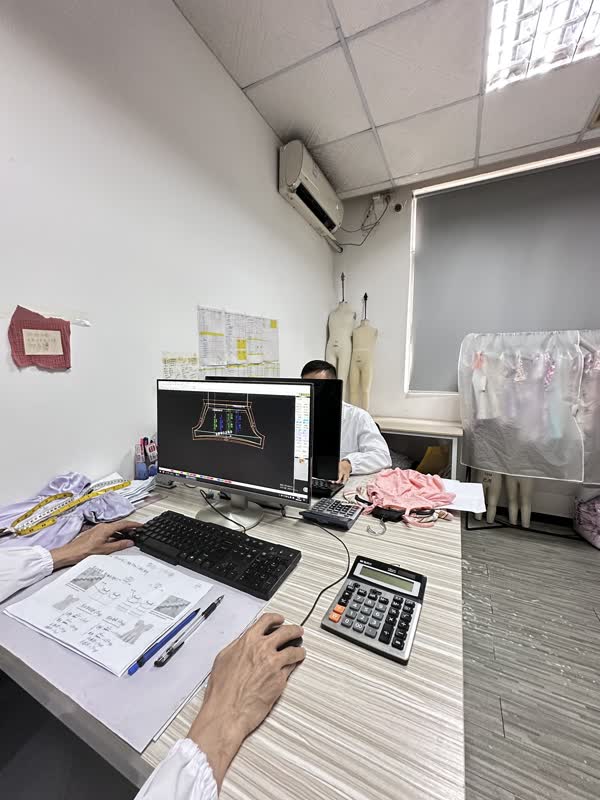
Most first orders start with a garment you already own. You send a reference garment, we measure it flat on the table, and a pattern gets drafted from those numbers. As a cut and sew manufacturer we do this most weeks, and it is where expectations and physics quietly part company.
Can a factory copy a sample exactly? Close, never exact. Three things always move: the fabric weight, the block underneath the design, and the inside construction you cannot see from outside. A 165 gsm satin and a 145 gsm satin hang differently in the same colour, and no amount of pattern work hides it.
Measuring a reference garment: 14 numbers, 40 minutes
We lay the garment flat, zipped or buttoned, and measure without stretching anything. Fourteen numbers: bust, waist, hip, shoulder, sleeve length, armhole, bicep, cuff, front length, back length, hem sweep, neck width, neck drop, and rise on a trouser.
Those numbers are the brief. Photos are not, because a photo has no scale and every model stands differently.
If you also tell us the label size and the fibre composition, the first mock-up lands closer. That is 40 minutes of work and it usually saves a round.
What a reference sample cannot transfer
Fabric is the obvious one. If the original is a 165 gsm viscose crepe and the closest available shade is 145 gsm, the garment will be 4 per cent lighter and the hem will fall about 1.5 cm differently on a body.
Hidden construction is the second. Whether the facing is bagged out or stitched to the lining, whether a 1 cm stay tape sits in the shoulder, whether the hem is 2.5 cm or 4 cm. Some of that you can feel through the cloth. The rest we open a seam to see.
The block is the third, and the one brands underestimate. The original was drafted on somebody's fit model. We can copy its measurements at one size, but grading to five sizes means inventing a grade rule that may not match the original's proportions at all.
Is copying a garment legal?
Construction and measurements are not protected. You can ask a factory to build with the same seams, the same hem depth and the same fit.
Logos, brand labels and prints are a different matter. We will not reproduce a third party's logo, woven label or printed artwork, and a factory that says yes to that is telling you something about how it will treat your artwork too.
Distinctive trade dress sits in between. A specific buckle, an unusual panel line, a signature print repeat. If a design is that recognisable, take advice before you cut, not after.
Pattern from a sample: cost and days
Drafting from a reference garment costs $120 to $220 and takes 3 to 5 working days. Grading to a five-size set adds $60 to $100.
Then a mock-up at $90 to $160, and usually a second one. Call it three weeks from parcel to approved sample, provided the fabric is in stock.
A factory quoting $30 for this is either pulling a block it already owns or not grading at all. Both show up in bulk, and neither shows up in the sample.
The 2019 copy that fit nobody
In 2019 a client sent a satin slip dress to copy for a 40-piece run. The original had a bias-cut facing at the neckline, about 2 cm deep, cut on the true bias so it would follow the curve.
We converted it to a straight-grain facing because it was faster to cut. It looked correct on the table and it passed the mock-up.
After the first wash, the neckline on 11 pieces had twisted 1.2 cm to one side. The bias facing had been holding the curve and the straight grain pulled it. We remade 11 pieces at $7 each and shipped four days late.
That is the kind of detail a garment carries and a photograph does not. We now photograph every inside seam of a reference before drafting anything.
When the reference is the wrong size
Brands usually send a sample in their own size. That is fine for construction and close to useless for a size run, because the measurements anchor one point and nothing else.
What we need on top is the body the garment was made for: bust, waist, hip and height. From those four numbers we can sanity-check the grade before anything is cut.
If the reference is a size 8 and your customer is a size 14, the honest move is to draft from the 8, grade up, and fit the 14 first. Fitting the middle size first is how a 14 ends up 2 cm short at the waist and nobody notices until a stockist measures it.
What to send with the garment
Six things: the garment itself, its label size and composition, your own flat measurements if you have taken them, three photos of the inside seams, one worn photo, and the single detail you care about most.
That last one is not a formality. If the shoulder is the point of the design, say so, because we will spend the pattern budget there and simplify somewhere you do not mind.
If the original is no longer available, a tech pack works instead, and our FAQ covers what a minimum viable one contains. The cut and sew service page lists what you supply against what we do, and the case studies show runs we built from a client's own sample.
Go deeper: what a tech pack must contain · who owns the pattern you paid for · why mock-ups come back wrong
Questions we get about this
Can you copy a designer garment I bought?
We can build to its measurements and construction. We will not copy a logo, a label or a print, and we will tell you if a design looks like protected trade dress before you spend on a pattern.
Do I need a tech pack if I send a garment?
No. The measurements become the spec. But the moment you want a second colourway or a size run, a written spec sheet is what stops the two versions drifting apart.
Quick Take
14 flat measurements. Photos have no scale and every model stands differently.
$120 to $220, 3 to 5 days. Grading to five sizes is extra, and it is where the fit drifts.
Fabric weight moves the fit. 165 versus 145 gsm is about 1.5 cm at the hem.
About UP Fashion
UP Fashion is a Guangzhou garment manufacturer founded in 2016, run by a team with 20+ years of OEM experience in silk, viscose and embroidery. We quote from 30 pieces, show the rate we used, and inspect three times before shipping.





