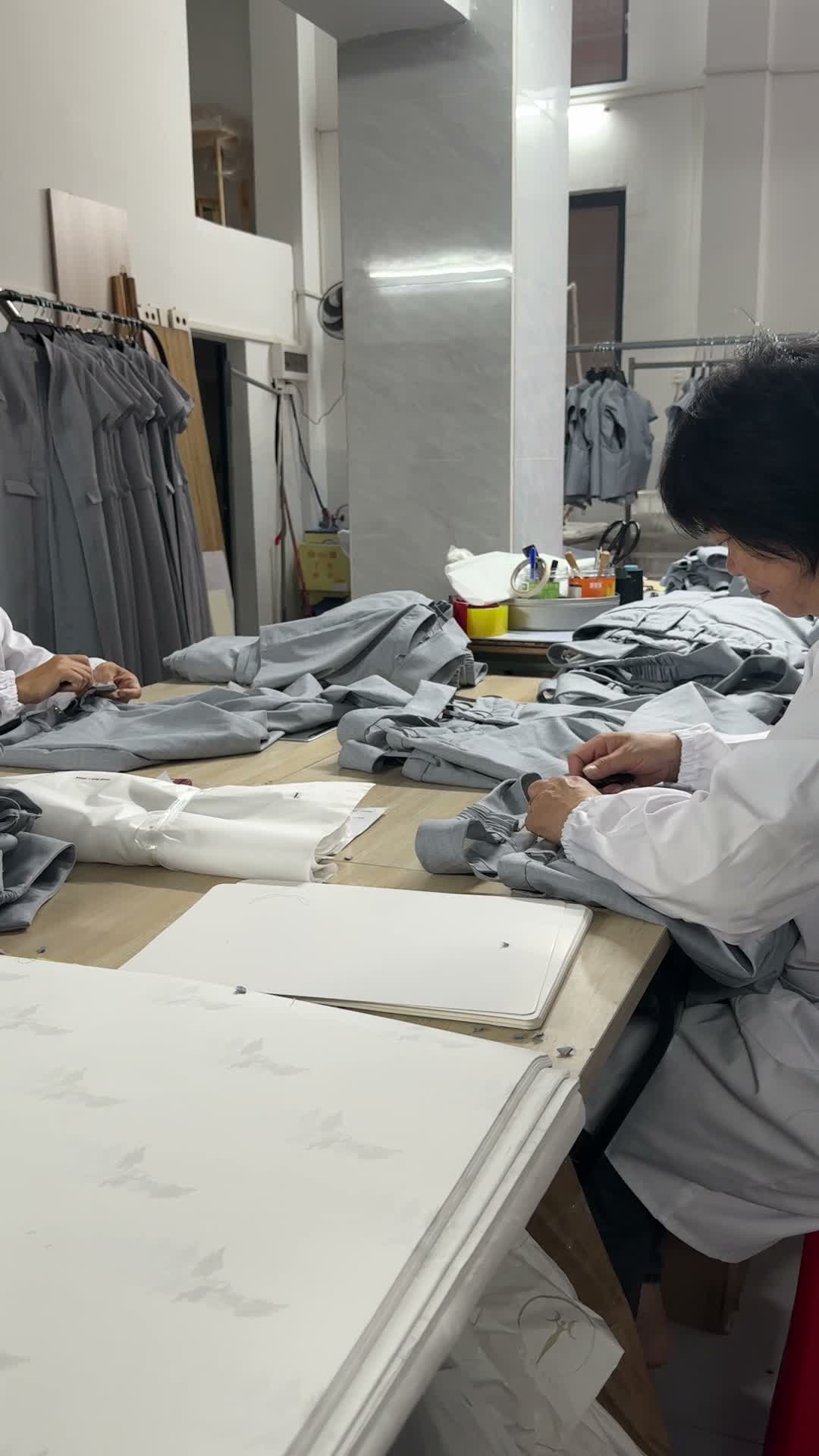
A high end clothing manufacturer can inspect its own work and still miss what a buyer sees at arm's length. That is why third-party inspection exists, and why we recommend it on a first order rather than every order. Nobody in the chain is neutral when the factory is paying for the report.
One man-day in Guangzhou costs $250 to $350. On a 30-piece run that is $8 to $11 a garment, which is either cheap insurance or 12 per cent of your FOB, depending on what the order is worth to you.
What a third-party inspection costs and covers
The fee buys a man-day, not a guarantee. Travel outside Panyu or Zhongshan adds $40 to $80, and booking between August and October needs seven to ten days' notice because every brand wants its check before the same shipping window.
The report runs four to six pages: quantity and carton check, a measurement chart against your spec points, defect classification, packing and label check, and photographs of every defect found.
The inspector opens a sample, not the lot. That is the part brands misread, and it is why a passed inspection is not a promise about every garment in the box.
AQL 2.5 on 30 pieces: eight garments, one defect
Under ISO 2859-1 at general level II, a lot of 26 to 50 pieces draws a sample of eight. At AQL 2.5 that sample accepts zero major defects and rejects the lot at one.
So a single puckered seam out of eight garments fails thirty. That sounds harsh until you remember the inspector cannot open the other twenty-two, and the factory knows which eight were opened.
Critical defects are always zero, at any AQL level: needle damage, a wrong care label, a measurement outside the tolerance table, anything that makes the garment unsellable.
Some brands move to AQL 4.0 so that one defect passes. On a lined garment we would not, because the defects that survive 4.0 are the ones a customer photographs and sends back.
When to pay for a third party, and when not to
Pay for it on a first order with any factory, on an order above $3,000, on anything with a stockist date you cannot move, and whenever part of the work is sub-contracted to another workshop.
Skip it on a reorder of a style that already passed, and on a 30-piece run where you approved the PP sample and receive inline photographs every day. At that size the fee can reach 10 per cent of the order.
There is a third case, which is a factory that refuses. That is not a reason to skip the inspection. It is the reason to book one.
What the report cannot tell you
It measures against the spec you supplied. If your spec says nothing about hem length, the inspector uses the factory's sheet, and the argument starts from their number rather than yours.
It says nothing about fit or drape. A garment can pass AQL 2.5 with a shoulder sitting 8 millimetres off, because nobody put the shoulder in the spec.
It samples. Eight garments out of thirty means twenty-two were never opened, and a good factory will tell you which eight it would have chosen.
What it also cannot tell you is whether the factory will fix what it finds. Ask that before you book, because a report with no remedy is a photograph of a problem you now own.
In 2021 a client booked an inspector without sending our tolerance table. The inspector measured hems against the factory's own sheet, failed six of eight pieces, and we spent four days proving they sat inside the spec we had signed.
The same year our own inline check passed nine satin dresses with puckered princess seams. The third party found them in twenty minutes. We reworked all nine in three days and paid for the reinspection ourselves.
How to brief an inspector so the report means something
Send five things with the booking: the spec sheet with every tolerance, photographs of the approved sample with a tape measure laid on it, the packing requirement, the label artwork, and the name of someone who answers within two hours.
Without the spec sheet, the report grades your order against someone else's standard. With it, the report is evidence you can act on, and the difference shows up the first time a lot fails.
Who pays, and what happens when the lot fails
The buyer pays the inspector, always. A factory that offers to pay is offering to choose the inspector.
Book the inspection for the day the goods are packed, not the day they are sewn. An inspector who arrives before packing can only check garments, while one who arrives after can check cartons, labels, polybags and the count as well.
When a lot fails there are three exits: rework and reinspect, ship with a credit, or cancel before the balance. Reinspection usually costs more than the defect, so we push for rework inside the same week.
Our own numbers are 3 to 8 per cent rework on a first run and 1 to 3 per cent on a reorder. An inspection that finds the 3 per cent early is cheaper than a claim that finds it at your stockist.
Our own rule is blunt: any first order above $2,000 gets checked by someone who does not work for us, whether the brand asks for it or not. We would rather be checked than trusted.
Our production standards are written to be inspected against, the case studies show what a failed lot looks like in practice, and the FAQ covers who pays for rework.
Go deeper: how AQL 2.5 and 1.0 differ on paper · what to check before you release the balance · what a remake really costs a small run
Questions we get about this
Will you accept an inspector in your workshop?
Yes, with 48 hours' notice. We set up a table, hand over the measurement chart, and stay out of the way while they work.
Do you charge extra when an inspection fails?
No. We charge for the rework and show the hours. If the failure is our fault, the reinspection is on us.
Quick Take
$250 to $350 a man-day. On 30 pieces that is $8 to $11 a garment, against a claim that lands at your stockist.
AQL 2.5 samples eight garments on a 30-piece lot. One major defect rejects the lot, because the other 22 were never opened.
Send the tolerance table with the booking. Without it the report grades against the factory's sheet, not yours.
About UP Fashion
UP Fashion is a Guangzhou garment manufacturer founded in 2016, run by a team with 20+ years of OEM experience in silk, viscose and embroidery. We quote from 30 pieces, show the rate we used, and inspect three times before shipping.





