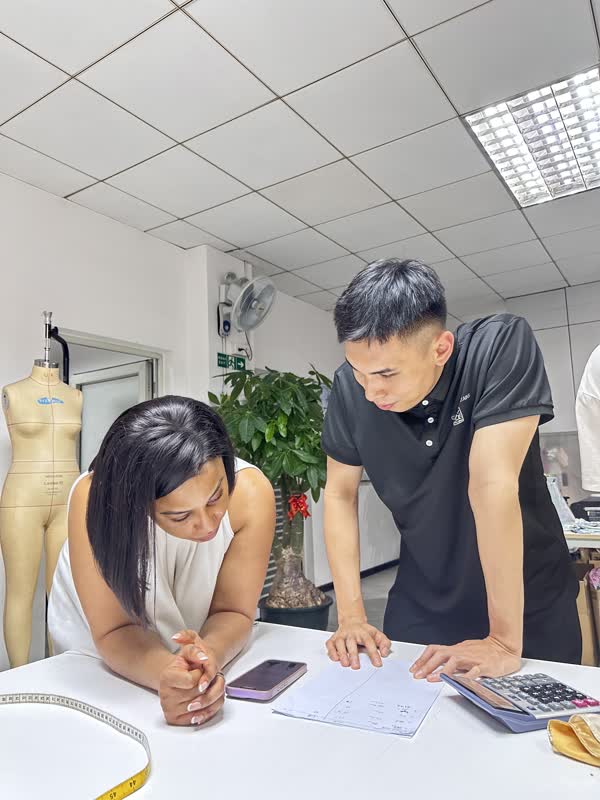
A small batch clothing manufacturer and a trading desk can look identical on a website, and most buyers never get on a plane to check which one they emailed.
Four things are checkable from a desk in about a week: a continuous video walk, the pattern archive, the mill invoice and the licence scope. Two things are not: whether the operator is skilled, and whether the factory still answers you in month three. The second pair only shows up in a trial order.
Here is the order we would run the checks in, what each one costs, and the year a brand skipped all of it.
The 40-minute video factory tour that replaces a visit
Ask for one call, no cuts, from the gate to the cutting table to the sample room to the sewing floor. Do not accept a highlight reel.
Watch three things: how many machines are actually running, whether the cutting tables are clear, and whether anyone in the frame glances at the camera before answering a question.
A real floor has noise, offcuts on the ground and somebody shouting about a bundle. A showroom is silent, and silence is the tell.
Ask two questions while the camera is still moving. What style is on the table right now, and how many pieces are in that bundle? Someone reading from a script cannot answer either one at walking pace.
Documents a factory can produce in 24 hours
- Business licence with the 生产 (manufacture) scope line, not 贸易 (trade).
- A pattern card for an older style, with a date and a style number that is not yours.
- A fabric mill invoice from the last 90 days, showing metres and price per metre.
- Two AQL inspection reports from other clients, with the names removed.
- An SMV sheet for a comparable style, in minutes per operation.
Anyone can fake one of those. Faking five that agree with each other is real work, and most trading desks will not bother.
A sixth document is worth asking for: a bill of lading from the last month. It shows a real export, a real destination country and a real volume, and it is harder to invent than a licence because the shipping line already has a copy.
The sample order as a test, not a gift
Pay for one sample in your own fabric. It costs $85 to $140 and it is the only step that tests the thing you actually care about, which is what happens when the material is difficult.
Send fabric with a known flaw in it and see whether they flag it. We photograph any fault before cutting and ask the buyer to confirm, because a 4 cm hole at sample stage becomes a short shipment at 300 pieces.
A factory that cuts through your flaw without calling you will cut through worse later, and you will find out in a claim email.
Two things you cannot check from a desk
Skill and durability. A video call shows you a floor, not a hand, and it says nothing about whether the same person replies in week twelve.
The workaround is a trial order: 30 pieces, three inspections, a written rework clause and a named contact. That is $4,000 to $9,000 depending on the garment, and it tells you more than any audit report.
The alternative is a local agent on a day rate, $150 to $300 plus travel. That works when you need eyes on one specific problem. It works less well as a character reference, because an agent paid per visit has an interest in finding more visits.
Where the deposit goes, and why it decides the deal
Pay to a company account whose name matches the licence, and read that name before you transfer. It is the cheapest fraud check on offer and it takes four minutes.
If the account belongs to a person, or a third company, or an address in another province, stop and ask why. A Guangzhou factory can explain a Hong Kong holding company in one sentence. Nobody can explain a personal account 800 km away.
We invoice from the company that signs the contract, and we send the licence with the invoice so the two names can be compared by someone who is not us.
What went wrong when a brand skipped every step
In 2019 a brand signed with a supplier whose website showed a factory floor. The floor belonged to the neighbour, and the deposit went to a desk with two staff.
Their 60-piece run came back with the wrong lining and no inspection report at all. We took the reorder, and the first thing we did was a live walk-through on a Tuesday morning, because Monday floors are staged.
Our A1 production assistant, still in training and coming online later this year, is being taught to ask for the pattern card date before anything else.
A one-week remote check, in order
- Day 1: the unbroken video call, 40 minutes, no edits.
- Day 2: the five documents, in one email.
- Day 3: sample order placed, with your fabric and a deliberate flaw.
- Day 4: two quotes broken into the same 12 lines and compared.
- Day 5: a third-party inspection quote, so you know the price of doubt.
If a supplier cannot manage all five inside a week, that is your answer, and it cost you nothing to find out.
Then run it again on a second supplier. One factory is a price, two factories are a range, and the range tells you what the market thinks your garment is worth before you commit a deposit.
What to send us for a remote start
Send the tech pack or photos, the size run and the ship date. We will do the video walk, send the documents and quote the trial order in the same reply.
Our small batch programme is built for buyers who never visit. The FAQ covers deposits and inspection, and the case studies include the reorder we inherited in 2019.
Go deeper: 90 minutes on a factory floor · the papers behind a factory audit · testing a factory with 30 pieces
Questions we get about this
Can I verify a garment factory without visiting China?
Most of it, yes. A continuous video walk, a pattern card for an older style, a mill invoice and the manufacture line on the licence settle whether there is a real floor. Skill and reliability only appear in a trial order of 30 pieces with three inspections. Budget $4,000 to $9,000 for that test and treat it as tuition rather than cost.
Is a third-party inspection worth $300 on a 30-piece order?
On 30 pieces, usually not. Our own three inspections plus dated photos cover the same ground for less. It becomes worth the $300 from about 150 pieces, or when you have never worked with the factory before. On a first 30-piece run, put the money into a better sample instead.
Quick Take
40 minutes. One unbroken video call, gate to sewing floor. No edits, no highlight reel.
5 documents. Licence scope, pattern card, mill invoice, AQL report, SMV sheet. One email, one day.
$85 to $140. One sample in your own fabric, sent with a deliberate flaw. The only real test before bulk.
About UP Fashion
UP Fashion is a Guangzhou garment manufacturer founded in 2016, run by a team with 20+ years of OEM experience in silk, viscose and embroidery. We quote from 30 pieces, show the rate we used, and inspect three times before shipping.





