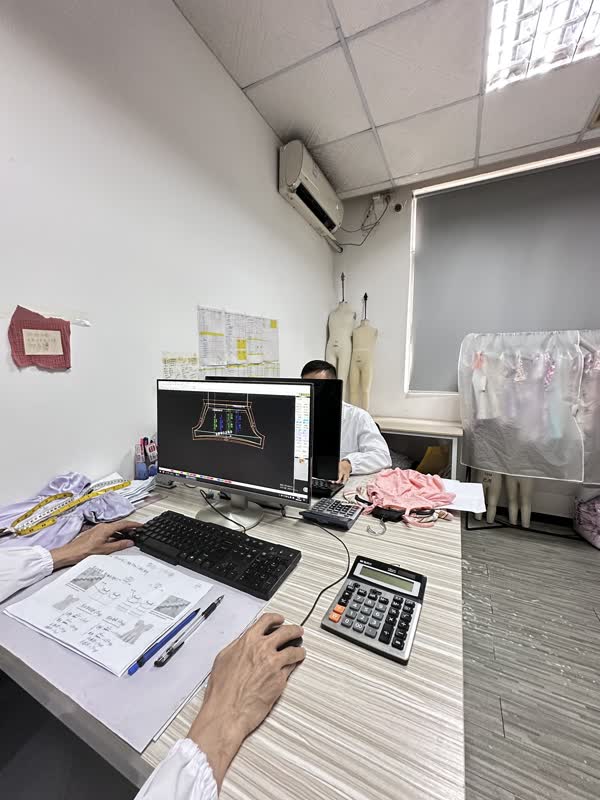
A high end clothing manufacturer is judged on fit before it is judged on price, and most brands approve the first sample that looks right on a hanger. Six checks take about forty minutes and catch the faults that surface at the wrong moment.
What should you actually check before you approve a womenswear sample? Measure it against the spec sheet at five points, look inside at the seams, put it on a body and wear it for an hour. A sample that passes a mirror and fails a tape measure costs a season.
Here are the six, in the order we run them at the approval meeting.
Check one: five measurements against the spec sheet
Bust, waist, hip, length and armhole. Measure the sample flat, then measure it on the body, and write both numbers down.
Our tolerance is plus or minus 0.5 centimetres on those five points and plus or minus 1 centimetre everywhere else. Symmetry is 3 millimetres, which means the left and right side seams should match each other before they match the spec.
A garment can be 1 centimetre off the sheet and still fit well. The same garment 1 centimetre off across two sizes fits badly, and the sheet is a starting point rather than a verdict.
Check two: seam allowance and the inside of the garment
Turn it inside out. Look at the seam allowance, the overlocking and the hem finish. One centimetre is our standard, and 1.5 centimetres at stress points like the armhole, the side seam at the hip and the back waist.
Stitch density belongs here too. Ten to twelve stitches per inch on a woven seam holds. Six to eight looks fine in a photograph and starts opening after three wears.
Inside finish is where a cheap garment shows itself first. Nobody sees it in a lookbook, and everybody sees it when a customer returns a dress.
Check three: dart, armhole and shoulder placement on a body
Put the garment on a fit model and look at the dart apex. On a bust dart it should sit 2 to 3 centimetres away from the bust point, not on it.
Then look at the armhole from the side. If there is a gap under the arm while the model stands still, the armhole is too low or the shoulder is too wide.
Shoulder seam placement decides whether a garment reads as tailored or as borrowed. The seam should finish at the edge of the shoulder bone, within 0.5 centimetres.
Check four: two sizes of the same style side by side
Lay the smallest and the largest size of the range on the table together. Then measure the grade step between them. Our womenswear grade runs bust plus 5 centimetres, waist plus 4.5 and hip plus 5 per size.
Grading is where womenswear fails quietly. A grade rule copied from a knit pattern onto a woven dress will hold at size 8 and collapse at size 14.
In 2021 a client approved a range from a size 8 sample and we cut five sizes from it. The size 14 armhole gaped 2 centimetres, six garments were re-cut and the run shipped nine days late. We now make the round two sample in the smallest and the largest size, which costs about $180 and has not failed since.
Check five: press the garment and watch the cloth
Press the sample on the setting you will use in production. Viscose and rayon move under heat, and a satin face can shine if the iron is too hot or the cloth is pressed damp.
Watch the hem. A hem that ripples after pressing has been cut off-grain or the cloth was not relaxed before cutting. Rippling does not settle after the first wash.
Look at the colour under two lights, ideally daylight and a shop light. Two rolls from one dye lot can still read differently under different light, which is why we check with a grey scale against a level 4 to 5.
Check six: wear it for an hour before you sign
Sit down, walk, lift your arms, climb stairs. An hour on a body finds the pulling at the back waist and the hem that rides up, and neither shows up on a mannequin.
Every garment in a bulk run is tried on a mannequin at the end of the line, and one in ten is tried on a fit model. That is our floor, not the standard we aim for.
If a garment fails at this stage it is still a sample and it costs a week. If it fails after 300 pieces are packed, it costs the season.
What these six checks cannot tell you
They cannot tell you whether the cloth will still look right after twenty washes. A wash test at the start of the run answers that, and it has to happen before cutting.
They cannot tell you whether the customer will like it. Fit is measurable, taste is not, and no factory can grade taste.
What they can do is remove the four faults that come back most often: a grade that collapses at the top of the range, a seam that opens, a hem that ripples and a dart that sits in the wrong place.
Our high end production page sets out the standards we hold, and the FAQ page answers the fit questions we get most. The case studies page lists delivered runs with the fit problems we solved on each. Our production process page maps the two mock-up rounds and the three inspections. The Fashion Pains Solver we are bringing online is being built to read a sample measurement sheet against a spec sheet and flag the points outside tolerance.
Go deeper: what "perfect fit" means: 5 numbers a factory should publish · why your size 8 fits and your size 14 doesn't · high end clothing production: the 8 standards we hold
Questions we get about this
What tolerance should I accept on a womenswear sample?
Plus or minus 0.5 centimetres on bust, waist, hip, length and armhole, and plus or minus 1 centimetre on everything else. Symmetry should hold within 3 millimetres. Anything wider than that will show as a pull at the side seam once the garment is on a body.
How many sizes should the approval sample come in?
At least two: the smallest and the largest of your range. A single middle-size approval hides a grade rule that fails at the ends. The second sample costs about $180 and prevents the re-cut that costs a week and six garments.
Quick Take
Five points, 0.5 centimetres. Bust, waist, hip, length, armhole. Symmetry within 3 millimetres before spec.
Ten to twelve stitches an inch. Below eight the seam looks fine in a photo and opens after three wears.
Approve two sizes, not one. A size 8 approval in 2021 cost us six re-cut garments and nine days.
About UP Fashion
UP Fashion is a Guangzhou garment manufacturer founded in 2016, run by a team with 20+ years of OEM experience in silk, viscose and embroidery. We grade womenswear from a fit model, try every bulk garment on a mannequin and inspect three times before shipping.





