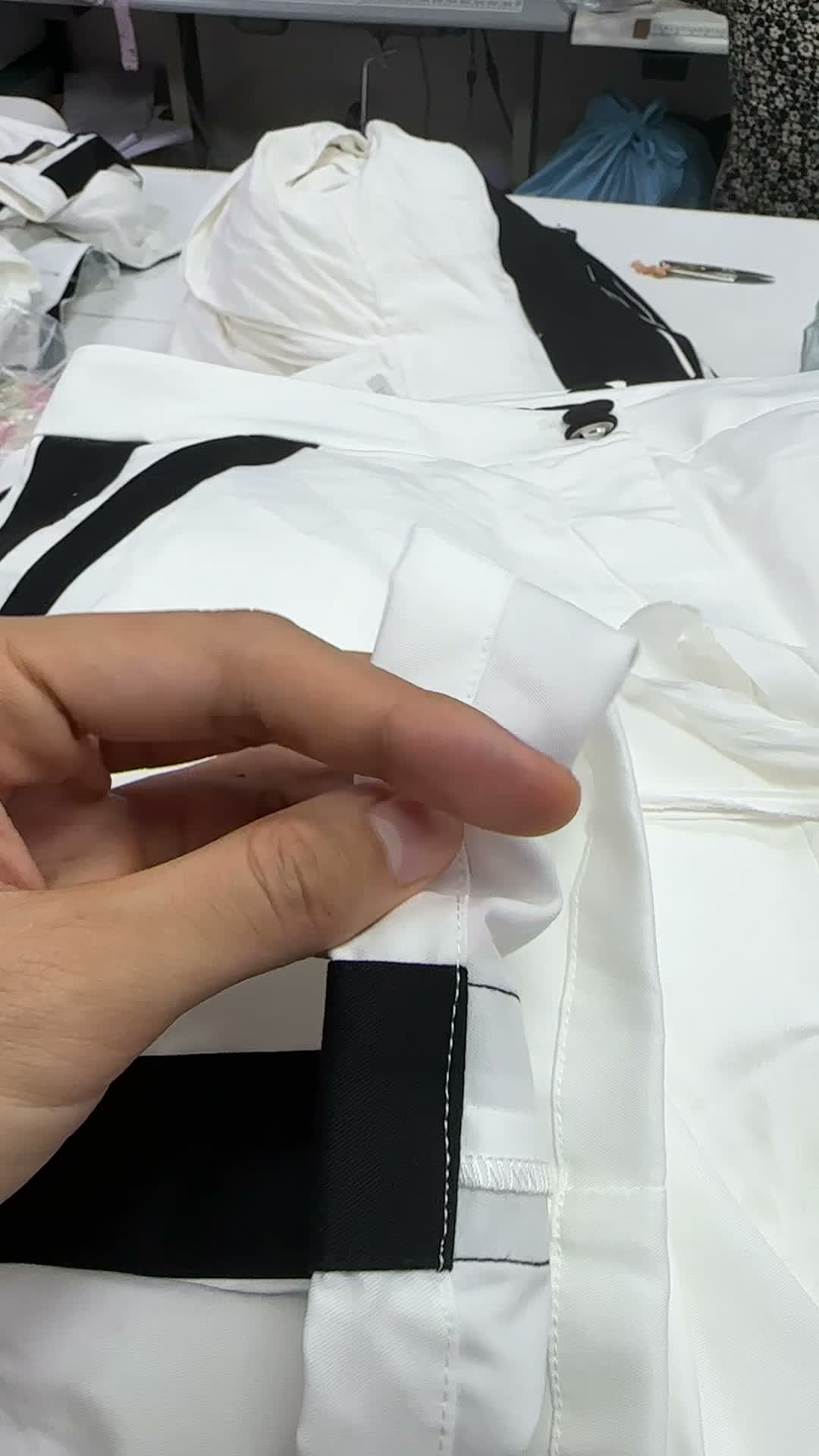
A high end clothing manufacturer charges $1.10 to $2.40 a garment to blind-hem a dress, and $0.45 to $0.80 for a plain hem. On 30 pieces that is roughly $55 against $20.
The choice is not the price difference. A blind hem disappears from the outside and lets a fluid fabric fall straight. A plain hem shows a stitch line and holds a crisper edge. Decide by fabric and by how close the customer looks, not by $1.20 a piece.
Blind hem vs plain hem: cost per piece and when each one fails
Our finishing line charges by the minute, so the numbers above are time multiplied by rate. A blind hem takes four to six minutes on a dress. A plain double-fold hem takes 90 seconds to two minutes.
At 30 pieces, blind hemming one style is about half a shift for one operator. That is the real constraint, not the $35. The blind machine sits with one style for three hours while nothing else moves through it.
Hem allowance: 4 cm, 3 cm, and the 6 mm that shows through
A blind hem needs fabric to fold into. We cut 4 to 5 cm on a dress, 3 cm on a skirt and 2.5 cm on a trouser. Under 2 cm the curved needle has nowhere to bite.
The bite is the whole craft. The needle picks up 2 to 3 mm of the outer fabric and no more. At 4 mm it reads as a dotted line on the face once the hem is pressed.
Stitch length matters as much. We run 4 to 5 mm on the blind machine, because a shorter stitch pulls the hem into a wave on viscose.
Which fabrics take a blind hem at 30 pieces, and which do not
Viscose, wool crepe, cotton-linen and most satin take it well. Polyester taffeta and coated fabrics do not, because the needle leaves a mark that pressing cannot lift.
On a bias-cut slip dress, hang the garment 48 hours before hemming. The bias drops 6 to 10 mm in that time. A hem cut on day one sits uneven by day three.
Silk is where we hand-sew. A hand blind stitch on silk runs 25 to 35 minutes a garment and $6 to $9. No machine we own matches it.
What goes wrong in the hemming section, and what it costs to fix
Three failures cover most of it: a bite that is too deep, an allowance that is too narrow, and a hem level measured from the waist instead of the floor.
In 2018 we hemmed 30 viscose dresses at a 5 mm bite. The line looked clean on the table and read as a dotted seam after final press. We re-hemmed all 30, lost two days and about $140.
We now press the first garment before the operator runs the rest. That check takes four minutes and it has saved us twice since.
How to write a hem spec your factory can actually follow
Give the hem type, the finished depth, the stitch length and the thread. "Blind hem, 4 cm finished, 4 mm stitch, matching thread" is a spec. "Nice hem" is not.
Add the measurement points. We measure depth at centre front, side seam and centre back. A hem that is 4 cm at the front and 3.4 cm at the side is a spiral, and it shows when the dress hangs.
If the hem carries a topstitch, give the distance from the fold to the millimetre. We run 1 mm on a plain hem and 6 mm on a twin needle.
What a blind hem adds to a $250 dress and a $900 gown
On 30 pieces the blind hem costs about $34 more than a plain hem. That is $1.13 a dress, and it is the cheapest visible upgrade on the whole garment.
At a $250 retail the hem is seen by the customer and by the stockist who opens the box. At $900 it gets photographed for the lookbook, and a 2 mm wobble becomes a return.
Where it is wasted: a stiff fabric, a bonded hem, or a dress that ships folded in a bag. Nobody sees a blind hem through a poly bag.
Machine blind stitch against hand blind stitch, and the $6 gap
A machine blind stitch is what most factories quote. It is fast, it is consistent, and on a medium-weight woven it is invisible from 30 cm.
A hand blind stitch is what a couture house quotes. It runs 25 to 35 minutes a garment and $6 to $9, and on silk or a very fluid viscose it is the only version that does not leave a ridge.
The test is simple. Hold the hem up to a window. A machine blind stitch shows a faint line of dots at the bite depth; a hand stitch shows nothing at all.
On a 30-piece run the hand option adds $180 to $270. That is worth it on a $900 gown and rarely worth it on a $250 dress.
What we ask before we approve a hem on a small run
Does the fabric mark? We test on an offcut, press it and look again. Two minutes, and it decides the method.
Does the hem carry weight? A 4 cm blind hem on heavy satin will drop. A 3 cm plain hem holds. Weight decides depth more than style does.
And who sees it. On a $250 dress, the inside of the hem gets looked at. On a $900 gown it gets photographed.
We are training an agent to answer these before a person reads them. It is still in training, so for now the reply comes from our sample room, usually the same day.
Our high end program page lists the finishing standards we hold on every run. The FAQ answers allowance and hem questions, and the case studies include the dresses we had to re-hem.
Go deeper: what overlock, binding and French seams cost · why a bias slip dress needs 30% more fabric · what viscose does after one wash
Questions we get about this
Can you blind-hem a fabric that marks under the needle?
Usually not on a machine. We hand-sew silk and any coated fabric, at $6 to $9 a garment and 25 to 35 minutes each, or we switch to a plain hem with a deeper allowance.
How deep should the hem allowance be on a dress?
4 to 5 cm for a blind hem, 3 cm for a plain one. Deeper than 5 cm and the fold sits heavy on fluid viscose; under 2 cm the blind needle has nothing to catch.
Quick Take
$1.10 to $2.40. Blind hem against $0.45 to $0.80 plain, and about $34 more across 30 pieces.
2 to 3 mm. The bite that holds. At 4 mm it reads as a dotted line after pressing.
30 dresses, two days, $140. Our 5 mm bite on viscose, re-hemmed at our cost.
About UP Fashion
UP Fashion is a Guangzhou garment manufacturer founded in 2016, run by a team with 20+ years of OEM experience in silk, viscose and embroidery. We quote from 30 pieces, show the rate we used, and inspect three times before shipping.





