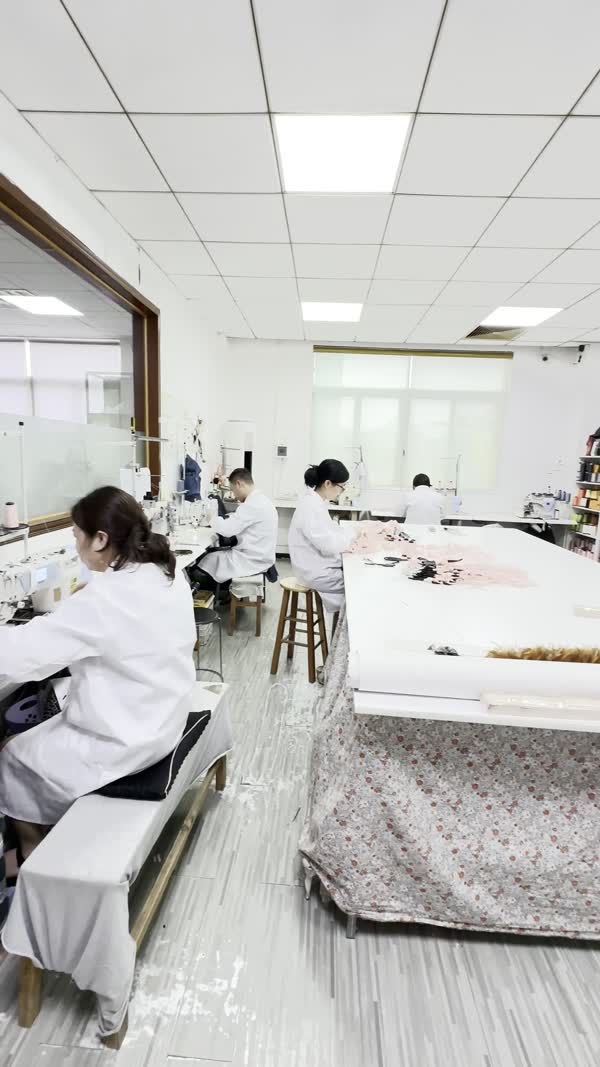
A small batch clothing manufacturer cuts 30 pieces in two or three lays, and every lay is a chance for the knife to drift. The panels that come out wrong are almost always the bottom ones.
Why are my panels inconsistent? Because a straight knife bends. The blade is 8 inches long and unsupported below the presser foot, so it leans away from the line as it travels down through the stack. The top panel is cut by the blade at the top; the bottom panel is cut by the tip, which is somewhere else.
On a 12 cm lay, the bottom panel can finish 2 to 3 mm wide on a curve. At 16 cm it reaches 5 mm, which is half a size at the hem.
Why a dull blade cuts a different size at the bottom of the lay
A sharp blade slices. A dull blade pushes, and the operator pushes harder to compensate, which adds lean on top of lean.
We sharpen every 2 to 3 lays, or every 40 to 60 metres of cutting, whichever comes first. A blade costs $9 to $14 and takes four minutes on the bench grinder.
Each cutting room keeps six blades in rotation so a change never waits for the grinder. A 30-piece run with three lays uses three blades, about $35 of consumable.
The tell is the edge itself. A dull cut looks slightly polished and the layers separate at the corner rather than holding square.
Blade speed and fused edges on polyester
Our straight knife runs at 3,400 rpm. On a 100 per cent polyester satin, that speed generates enough friction to melt the edge as it cuts.
A fused edge will not fray, which sounds like a benefit until you feel it. It reads as a crisp ribbon, shines under light, and will not drape with the rest of the panel.
We drop to 2,600 to 2,800 rpm on polyester and cut through a sheet of tissue paper above and below the lay. The paper takes the heat instead of the cloth.
On viscose and cupro we keep the speed up, because those fibres do not glaze and a slow blade drags the weave instead.
Lay height: what 30 pieces actually stacks to
Thirty pieces across three sizes is 10 layers per size. That is either three lays of 10, or one lay of 30 if someone is in a hurry.
Ten layers of 110 gsm viscose is about 5 cm of stack. Thirty layers is 14 cm, and the deflection at the bottom of a 14 cm lay is 4 to 5 mm on a curved seam.
Our limits are 6 cm for satin, 8 cm for viscose and cupro, and 10 cm for cotton poplin. Above that, the lay gets split whether the schedule likes it or not.
Splitting costs two extra setups of about 40 minutes each. It buys a millimetre, and a millimetre at the hem is the difference between two sizes.
The six measurements we take on every lay
After cutting, we measure the top panel and the bottom panel at three points: waist, hip and hem. Six numbers per lay, tolerance 2 mm.
If the bottom panel is outside tolerance, the lay is re-cut before it goes to the bundling table. Once panels are numbered and bundled, the fault is already in the run.
The six numbers go on the cut ticket with the fabric roll number, so a defect can be traced to a lay rather than to "the cutting room".
Pins, weights and tissue paper
Pins distort a lay. Every pin pushes the layers apart by the thickness of the shaft, which on 10 layers is measurable at the seam.
We weight the marker instead, and use pins only at the corner of a curved piece where a weight will not sit. On satin we pin inside the seam allowance and nowhere else, because a pin hole in the body of the panel is permanent.
A sheet of tissue paper between the bottom layer and the table stops the blade dragging the lowest panel out of line, which is the quiet cause of a short hem that no one can explain.
When we re-cut instead of trimming
Trimming a panel that is 4 mm narrow at the hem changes the hem curve and the grain line at the same time. It looks fixed and it is not.
Our rule: re-cut when the error is over 3 mm on a curved edge. Trim when the edge is straight and the allowance can absorb it.
Re-cutting needs fabric from the same dye lot, which is why we hold 8 to 10 per cent extra on small runs. On a 30-piece order that is 3 pieces of fabric sitting in the store.
The satin skirt we cut with a tired blade
In 2019 we cut a 30-piece satin midi skirt in three lays. The third lay went through a blade that was two lays past its change, because the grinder was in use.
Twelve hem panels finished 4 mm narrow. We re-cut them from 14 metres of the same lot, which cost three days and about $270 in fabric and labour.
Nothing was wrong with the pattern or the marker. One consumable item was treated as optional.
Now the blade count is written on the cut ticket and a lay cannot start past the count without a signature.
What to ask about a factory's cutting room
Four questions cover it. How many lays for 30 pieces, when is the blade changed, does anyone measure the bottom layer, and is the table vacuum or static?
A factory that answers "one lay" is optimising its own time, not your size consistency. A factory that cannot answer the blade question does not track consumables at all.
Ask for the six measurements on one lay of your own order. It takes five minutes and it tells you whether the tolerance exists outside a document.
Our small batch production page sets out lay limits by fabric, the case studies show a re-cut, and the FAQ covers who pays when panels are short.
Go deeper: how 30 pieces become four lays · tracking every panel through a run · where 100 metres gets rejected
Questions we get about this
Can I just order 3 extra pieces as insurance?
Yes, and it is cheaper than a re-cut. Three extra pieces on 30 is 10 per cent of fabric and about 4 per cent of the invoice.
Does a laser cutter solve this?
For synthetics it seals the edge and holds tolerance. For viscose and linen the burned edge yellows, so we still cut those with a blade.
Quick Take
The knife leans. A 14 cm lay drifts 4 to 5 mm at the bottom panel on a curve. Three lays of 10 drift under 1.5 mm.
Blades are consumables. Change every 2 to 3 lays. $35 per run, against $270 for one re-cut.
Measure six points per lay. Top and bottom at waist, hip and hem, 2 mm tolerance, written on the cut ticket.
About UP Fashion
UP Fashion is a Guangzhou garment manufacturer founded in 2016, run by a team with 20+ years of OEM experience in silk, viscose and embroidery. We quote from 30 pieces, show the rate we used, and inspect three times before shipping.




