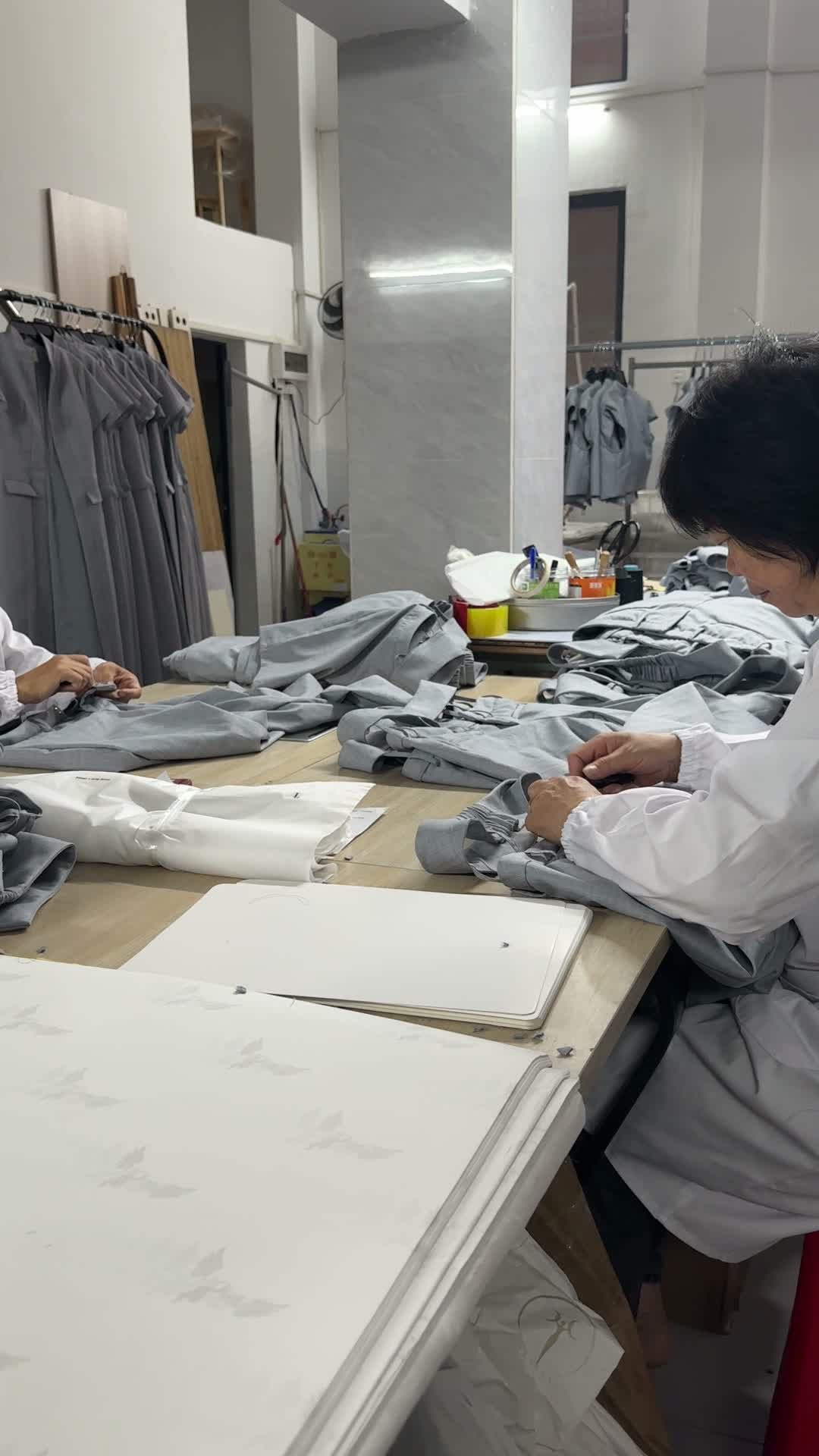
Every small batch clothing manufacturer charges more per piece below 50 units, and we are one of them. The question worth asking is not whether the premium exists but where it goes. Here is the arithmetic on a real 30-piece viscose dress, including the costs that never make it onto a quote.
The short answer: the sewing does not get expensive at 30. The setup, the changeover and the waste do. Once those three lines are visible, the premium stops looking like a markup and starts looking like a floor you can plan around.
The fixed cost that never shrinks
Pattern making, grading, two mock-ups, one final sample and line setup cost the same at 30 pieces as at 500. Call that block F. On a lined viscose dress with a zip and a facing, F runs about $1,100 with us, pattern $260, grading $180, mock-ups $340, final sample $180, setup and marker $140.
Divide $1,100 by 30 and you get $36.67 per piece. Divide it by 500 and you get $2.20. Fabric, thread and sewing minutes barely move between the two quantities. That one division is most of the gap, and it explains why a 30-piece quote and a 500-piece quote are not the same garment at different prices.
Where a 30-piece run's money actually goes
Take one style, 30 pieces, viscose at $4.20 a metre and 2.1 metres per dress including the marker allowance. Fabric comes to $264.60. Trims, invisible zip, hook and eye, thread, main label, care label, hangtag, come to $186 for the run, because trim minimums mean you buy for 50 and use 30.
Cutting and sewing runs $22 per piece, so $660. Finishing and pressing is $4 per piece, $120. Three inspections add $3.50 per piece, $105. The sample and setup block is the $1,100 above.
Total outlay is about $2,436, or $81.20 per piece.
Now the line most quotes leave out: freight and duty. A 12 kg air shipment to the US runs $180 to $260, and duty lands around 12 to 16 percent of the declared value depending on the HS code. Call it $380 landed. Your real cost is $2,816, or $93.87 per piece.
Then divide by what you actually sell rather than what you make. If you retail at $290 and sell 24 of the 30, your cost per garment sold is $117.33. That is the number to plan around, not the $81 on the quote.
The cost brands forget: deadstock, samples and cash
You bought fabric for more pieces than you made. On this run, 200 metres yields about 180 garments of this style, so 30 pieces used 63 metres and the rest sits on a shelf. If you never cut a second style from that roll, the shelf is a cost you paid for.
Sample costs are usually quoted separately and deducted from bulk once you order, which is fair. They still leave your account first. Two mock-ups and a final sample on this style were $520 spent before the bulk order existed, and that is cash flow, not unit price.
Payment terms deserve their own line. We ask 30 percent at order confirmation and 70 percent before shipping, so on this run you are out $845 before anything is cut and the balance before it leaves Guangzhou. If your retail sales land after delivery, plan for four to six weeks with money sitting in stock rather than in your account.
Two smaller lines matter more than they look. Packing materials and cartons run about $2.20 per piece at this size, and a carton standard your stockist will accept costs more than the cheapest one. An international transfer fee is usually $30 to $50, paid by whoever the agreement says.
When 30 is genuinely the cheaper number
When the style is unproven. Thirty pieces lets you catch a grading fault or a shade mismatch across one roll instead of across 500 garments. Fixing a grade and reordering costs you a week, while fixing 500 costs you the season.
When cash matters more than margin. Thirty pieces at a $94 landed cost ties up $2,816. Five hundred is roughly $47,000 before a single garment sells. If your sell-through is uncertain, the smaller number buys you information, and information is cheaper than inventory.
Our comparison of MOQ 30 and 500 works the per-piece side of this in more detail, including where the premium disappears.
How to lower the per-piece cost without lowering the standard
Four moves, in order of effect. Raise the quantity to 50 per style, which cuts the fixed block per piece from $36.67 to $22. Use one fabric across two styles so the roll is fully consumed.
Cut the marker tight, because an 8 percent yield gain on this order is $21. Move the shipment to sea freight if you have 30 days of slack, which saves roughly $120 here but adds three weeks you may not have.
What we will not do is remove inspection passes to hit a price. If a quote looks unusually low at 30 pieces, ask which of the three inspections it dropped, and ask for the fabric inspection record. Those two questions settle most price gaps in one email.
If you are still choosing a quantity, our small batch program sets out what we run from 30 pieces, and our FAQ page answers the cost questions we get most often. The case studies page has delivered orders with their numbers attached, and our production process page shows the three stages these costs map to. The Fashion Pains Solver we have in training and are bringing online soon is meant to do one job: name the pain before you spend money on samples.
Two things we do not make, so you can rule us out early: wool coats and knitwear. Our fabrics are viscose, polyester, linen, cotton-linen, satin, rayon and TR suiting. Saying that on the first call saves everyone a month.
Go deeper: MOQ 30 vs 500: the real cost per piece · cost per garment: the 6 lines your quote won't show · quote over budget? 5 cuts that hurt least
Questions we get about this
Why is the landed cost so much higher than the quote?
Because a quotation covers production, not delivery. Freight, duty and the trims you bought past the quantity you used all sit outside the unit price. On a 30-piece viscose dress, air freight and duty added about $12.65 per piece on a recent run, and trim minimums added roughly $2.50. Ask for a landed estimate before you approve the order.
Should I cost per piece made or per piece sold?
Per piece sold, always. Costing per piece made flatters the number. If you make 30 and sell 24, the same run costs about $117 per garment sold instead of $94 made. Plan your price against the sold figure and you will not be surprised when the last six pieces sit on the rail.
Quick Take
The premium at 30 pieces is setup, not sewing. Pattern, grading, mock-ups, final sample and line setup come to roughly $1,100 and do not shrink with quantity.
Add the lines quotes omit. Freight, duty and trim minimums turn an $81 piece into about $94 landed, a 16 percent difference you should price in from day one.
Divide by what you sell, not what you make. Selling 24 of 30 puts the real cost at $117 per garment sold, which is the number your retail price has to beat.
About UP Fashion
UP Fashion is a Guangzhou garment manufacturer founded in 2016, run by a team with 20+ years of OEM experience in silk, wool and embroidery. We run small MOQ production from 30 pieces per style, quote every order line by line, inspect each garment three times and publish the real cost maths, including the freight and duty lines other quotes leave out. This guide is how we help brands decide their first order size on numbers rather than hope.





