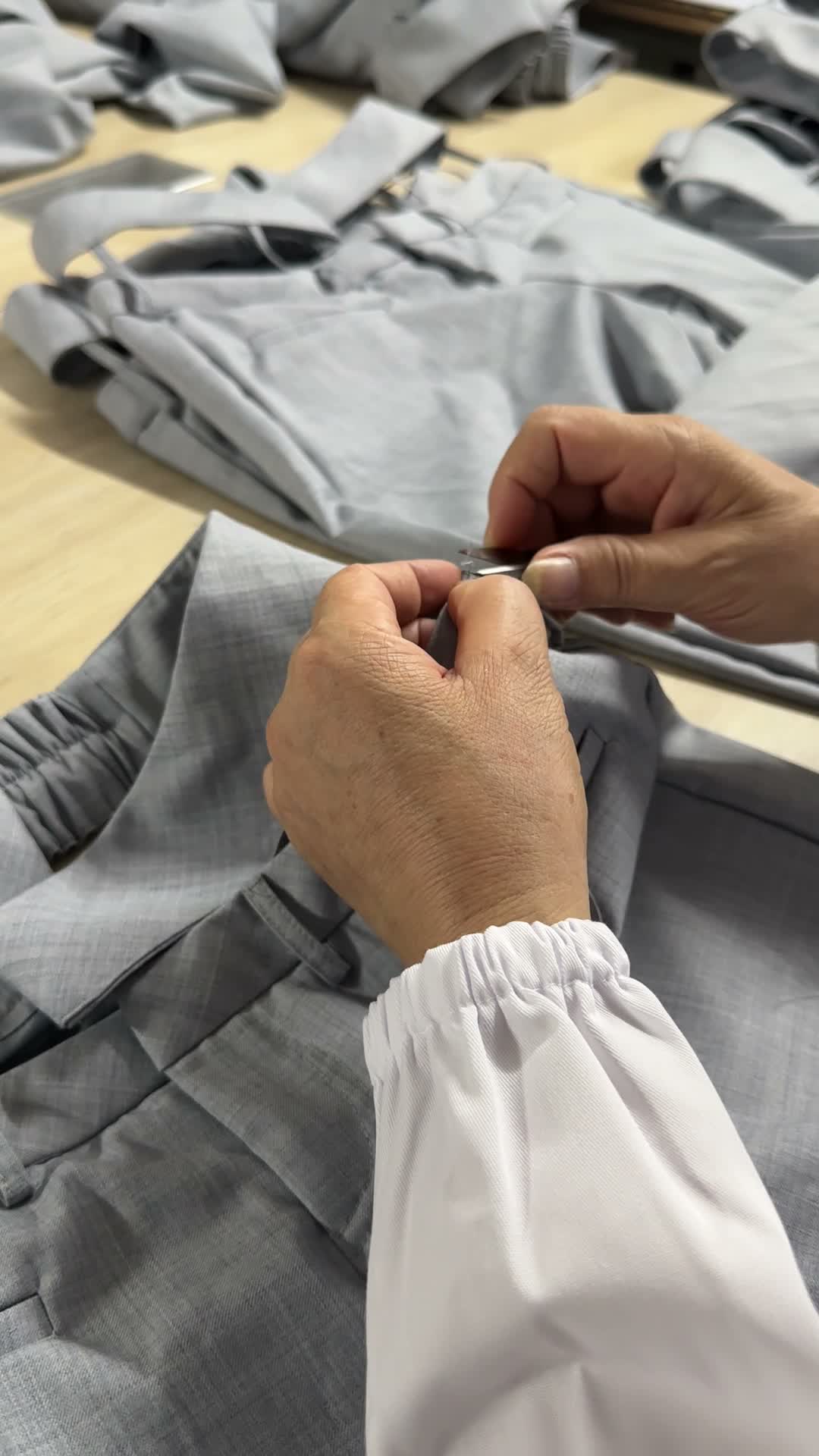
A small batch clothing manufacturer sees the same trouser fault on almost every first run: the fly puckers, the front dips when the wearer sits, and the waistband stands away from the back.
Why does the fly pucker on trousers that measured correctly on the table? Because a fly is a curve sewn onto a straight edge, and it is pressed one way or the other by whoever is standing at the machine. The block decides the rest.
We have re-cut 30-piece trouser runs for this three times. Below is what we now check before a block is approved, and what a 1 cm rise error cost a client in 2020.
Front rise and back rise: the 10 cm a trouser block needs
Size M in our trouser block has a 26 cm front rise and a 36 cm back rise, both measured from the crotch seam to the top of the waistband.
The 10 cm gap is not styling. A seated body needs 4 to 6 cm more length at the back than a standing one, and a woven fabric has no stretch to lend it.
Copy a front rise from a low-rise reference and keep the back at a high rise, and the waistband pulls down at the front every time the wearer sits. That is a 1 cm error that reads as a 3 cm problem.
Why the fly puckers: three causes on a 30-piece run
Almost every pucker we are asked to fix comes from one of three places, and none of them is the sewing operator.
Grain. The fly extension gets cut on the straight grain out of habit. On a curved fly it has to follow the curve, or the extension fights the seam and ripples about 1.5 mm every 10 cm.
Fusing. The extension is fused so it will not stretch. Fusible shrinks 0.6 to 0.9 per cent when it is pressed, so a 12 cm extension pulls in about 1 mm and takes the J-stitch with it.
Tension. A J-stitch at 9 stitches per inch on TR fabric puckers. We run 7 to 8 per inch at 2.8 mm from the fold, with a 90/14 needle and light presser foot pressure.
The J-stitch: needle, thread and 2.8 mm from the edge
The J-stitch is the topstitch that runs down the fly, curves under the bar tack and stops. It is the most visible line on the front of a trouser.
Our setting is 2.8 mm from the folded edge, 7 to 8 stitches per inch, polyester core thread at Tex 40, and a needle changed every 8 hours.
At 3.5 mm the stitch drifts off the fold on the curve. At 2.2 mm it catches the seam allowance underneath and the fly goes hard and shiny.
We sew a 15 cm scrap of the actual bulk fabric before the first pair. Sample fabric and bulk fabric do not sew the same, and most of these numbers came out of that scrap.
Waistband gaping at the back: the 1.5 cm dart nobody cuts
If the waistband stands away at the centre back, the block is missing a dart or the waist has been cut straight across a curved body.
Our size M waistband carries a 1.5 cm dart at centre back, tapering to nothing 6 cm down. Removing it to save one sewing step adds roughly 2 cm of gap at the spine.
This is also the fault that makes a customer size up. She buys a 12 to close the gap at the back, and then the hip is 5 cm too wide.
Seven numbers to check on a trouser block before you approve
Measure these on the pattern, not on the sample. A sample can be eased into looking right by one skilled hand, and bulk is not sewn by that hand.
- Front rise, 26 cm at size M.
- Back rise, 36 cm at size M.
- Thigh, measured 2.5 cm below the crotch seam.
- Knee, measured at the midpoint between crotch and hem.
- Hem opening, which decides the break over the shoe.
- Waist ease, 1 to 2 cm on a woven.
- Seat ease, 4 to 6 cm on a woven and 2 to 3 cm on a stretch.
Two of these are usually wrong on a block that arrived from another factory: the back rise and the seat ease. Both are invisible in a photograph and both are what a customer feels when sitting down.
The 2020 run where 30 trousers sat 1 cm low
In 2020 we cut 30 pairs of TR trousers from a block a client brought from her previous supplier. The front rise was 1 cm shorter than her fit model needed, and we did not question it because the tech pack said 25 cm.
Twenty-two pairs sold. Six came back with the same complaint, that the waistband sat under the stomach when sitting.
We took the rise out of the next run at no charge, but the first run was already in stores. The cost was a season of returns, not a repair bill.
Now we ask for the rise to be confirmed on a person before cutting, even when the number is written in the tech pack.
What to send with a trouser enquiry
Three things: the block you want copied, one worn pair you like the fit of, and the rise measured on a body. Photographs of a model standing are not enough, because a standing body hides both the rise and the seat.
Our small batch program runs trousers from 30 pieces per style, the case studies show a rise correction carried into a second run, and the FAQ explains how we handle a fit change after the mock-up stage.
Go deeper: the torso problems brands find too late · six fit checks before you approve · why panels twist after washing
Questions we get about this
Can you fix the fly pucker without re-cutting?
On a finished pair, no. The J-stitch has to come out, the fusing has to be replaced and the seam re-pressed. That is 25 minutes per pair, which is why we test on a scrap first.
Do you draft a trouser block from scratch?
Yes, and it is the better route when you have no block. Drafting plus one mock-up takes 10 to 14 days, and the block is yours once the development is paid.
Quick Take
Rise is two numbers, not one. 26 cm front and 36 cm back at size M. A 10 cm drop is anatomy, not style.
Fly pucker is grain and fusing. Follow the curve, expect 0.6 to 0.9 per cent fuse shrink, topstitch at 2.8 mm.
Check the block, not the sample. Seven numbers on paper, before anyone cuts 30 pairs.
About UP Fashion
UP Fashion is a Guangzhou garment manufacturer founded in 2016, run by a team with 20+ years of OEM experience in silk, viscose and embroidery. We quote from 30 pieces, show the rate we used, and inspect three times before shipping.





