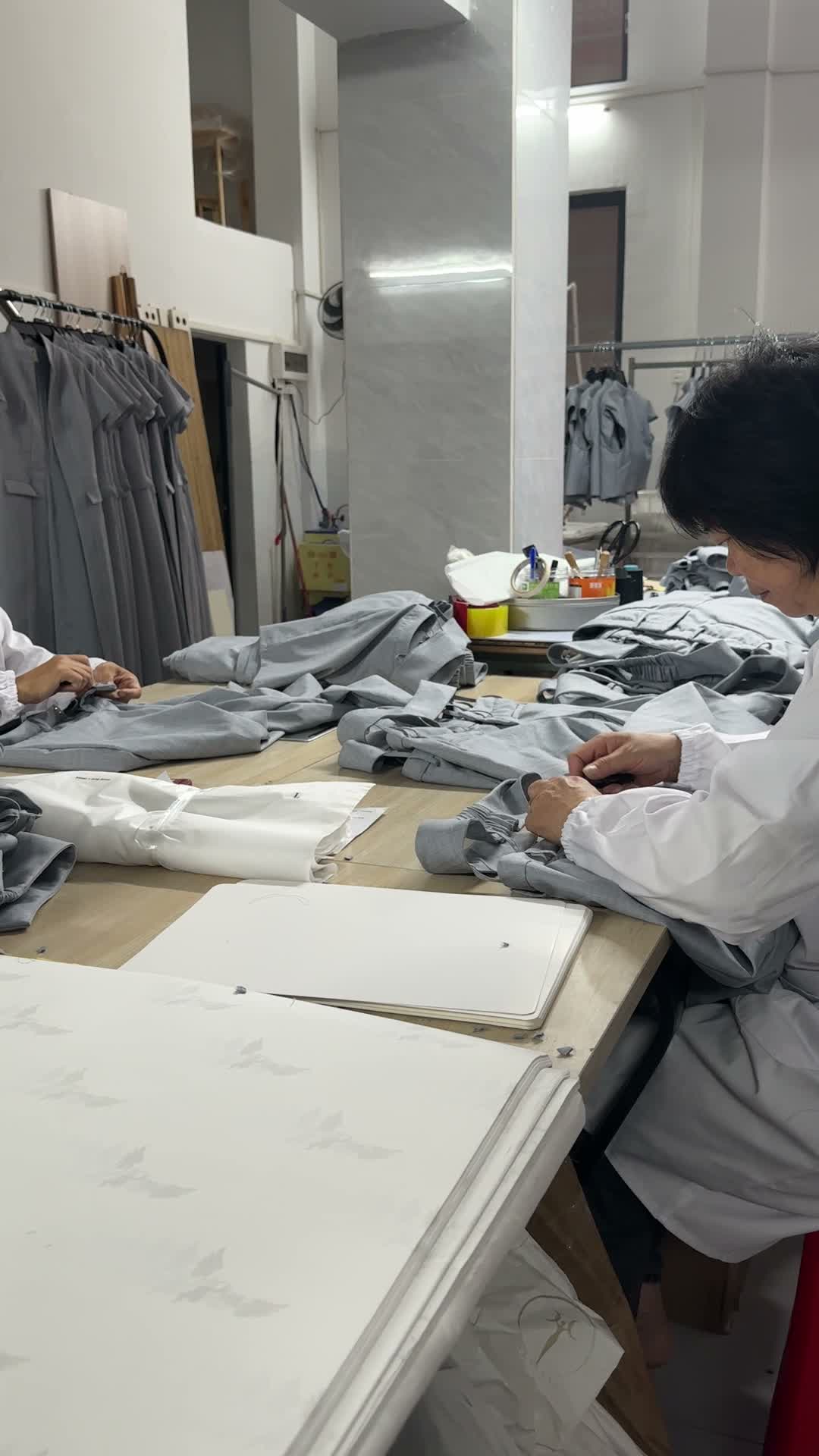
A cut and sew manufacturer puts a lead time on the quote, and that number assumes everything arrives on time. Ours is twelve weeks for a first run from deposit to shipping, and eight to ten for a reorder. When a run slides to sixteen, it is almost never the sewing that did it.
The honest breakdown is four blocks, and only one of them is time on a machine. Three weeks for quotation, fabric booking and lab dips. Three weeks for two mock-up rounds. Four weeks on the line, and two for finishing, packing and the shipping window.
Almost everything that goes wrong happens in the first six weeks rather than the last four. That is the part worth planning around.
How twelve weeks actually breaks down
Three of the twelve weeks pass before anyone touches a sewing machine. That surprises brands who expect the clock to start at the cutting table.
Week one starts the day the deposit clears and the fabric order is placed, not the day you approve the sample. Brands who count from sample approval lose three weeks on paper before anything has actually gone wrong.
Quotation and fabric booking is two to five days on our side, then the mill's own lead time on yours. Stock cloth ships in three to five days. Dyed-to-order adds two weeks for dyeing and one for lab dips you have to approve.
If you approve the lab dip late, the whole schedule moves by that delay. It is the single most common cause of a late first run.
Two mock-up rounds, and what a third one costs
Two rounds is our standard, and it is where fit gets fixed. Round one is the first fit on a live model. Round two confirms the corrections and becomes the sealed sample.
A third round adds ten to fourteen days, because the pattern has to be corrected, the fabric re-cut and the sample room re-queued. It happens when the comments on round two are contradictory rather than specific.
"Make it tighter but keep the ease" is not a comment we can act on. "Take 1.5 centimetres out of the waist at the side seam" is.
Line scheduling: where a small run waits
This is the block brands underestimate most. A 30-piece run does not get its own line for four weeks. It gets scheduled into gaps between larger orders, and those gaps are set about three weeks ahead.
So the date you get is the date the line can take you, not the date you asked for. In August, and again in the three weeks before Chinese New Year, the gaps close and small runs wait longer.
Two practical notes. A deposit does not buy a slot until the fabric is confirmed, because a line with no cloth is a line that gets bumped. And a public holiday week is not a working week, whatever the calendar says.
We will tell you the window before you pay a deposit. If your launch date cannot absorb it, better to know then than in week eleven.
Inspection, rework and the week nobody plans
Three inspections sit inside the four-week line block, not after it. Inline during sewing, end of line on the finished garment, and pre-shipment on packed cartons.
Rework is the wildcard. Most runs need two to four days of it. A run that fails the first inline check needs a week, and that week comes out of the schedule rather than out of thin air.
We will not ship a run that fails the inline check without telling you. On 30 pieces it usually means one machine's tension was off rather than the whole run being wrong. We fix the machine, re-cut the affected pieces, and the schedule absorbs the days.
Shipping and clearance: the two weeks you can compress
Sea freight to Europe or the US runs 28 to 35 days door to door. Air freight is five to seven days and costs roughly $6.50 to $9.00 a kilogram, which on 42 kilograms is real money.
What you can compress is the paperwork. A commercial invoice with the wrong HS code, or a packing list that does not match the carton count, can hold a shipment at destination for a week. That is not the factory's delay, but it is your calendar.
How to pull four weeks out of a small run
Four moves, in order of effect. Approve the lab dip within 24 hours, and approve the round-one comments in one pass with numbers rather than adjectives.
Then book stock fabric instead of dyed-to-order, and give us a three-week delivery window instead of a fixed date. Those last two are the ones brands resist, and they are worth the most.
Do all four and a twelve-week run can land in nine. Do none of them and sixteen weeks is not bad luck, it is arithmetic.
In 2021 we quoted nine weeks on a 60-piece run and delivered ten weeks and two days. We had not built any float around the second mock-up round, and the client had a stockist appointment. The number we quote now includes the float, which is why it reads twelve rather than nine.
Our cut and sew page sets out the four stations and what each one needs from you. The FAQ page answers lead time questions, and the case studies page lists delivered runs with their actual dates. Our production process page shows where each of the four blocks starts and ends. The Fashion Pains Solver we are bringing online will map your target launch date back to a deposit date and flag the blocks that cannot absorb a slip.
Go deeper: why most cut and sew factories say 300 pieces · nine checks before you send fabric to a cut and sew workshop · factory calendar: why August is the worst month to order
Questions we get about this
How long does a small production run take from deposit to shipping?
Twelve weeks for a first run on stock fabric, and sixteen to eighteen if the cloth is dyed to order. A reorder on an approved style takes eight to ten, because the pattern, the grade set and the corrections are already done.
Can you rush a small run if my launch date is fixed?
We can compress the paperwork and the lab dip approval, and we can air freight instead of shipping by sea. What we cannot do is shorten a dye cycle or a mock-up round without risking the fit. If the date is hard, tell us at the quote stage and we will tell you honestly whether it is achievable.
Quick Take
Twelve weeks, and only four of them are sewing. The other eight are quotation, lab dips, two mock-up rounds, finishing and shipping.
The first six weeks decide everything. A late lab dip approval or a vague round-one comment moves the whole schedule by exactly that delay.
Four moves can pull out three weeks. Fast lab dip approval, numeric fit comments, stock fabric, and a three-week delivery window.
About UP Fashion
UP Fashion is a Guangzhou garment manufacturer founded in 2016, run by a team with 20+ years of OEM experience in silk, viscose and embroidery. We quote orders from 30 pieces, publish our tolerances, and inspect three times before shipping.





