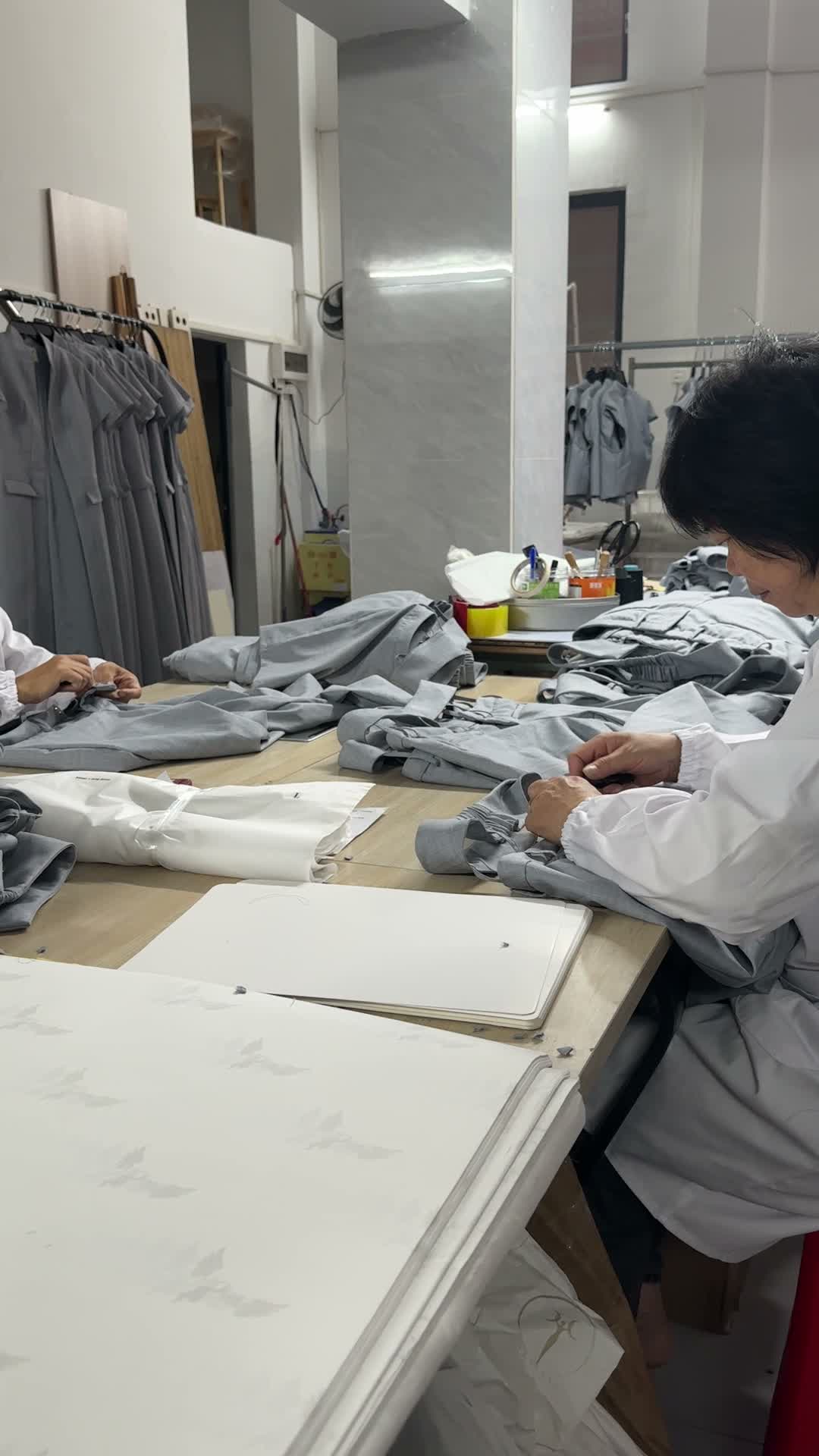
A rush order moves four things and none of the rest. As a small batch clothing manufacturer we can compress quoting, sampling rounds, line scheduling and finishing, but we cannot compress dyeing, fabric relaxation or transit. That is why the honest answer to a four-week request is no.
So how fast can a thirty to fifty piece order actually run? Eight weeks is realistic when the fabric is stock and you approve the first sample quickly. Twelve is normal. Six happens only when every stage lands in the right order and nothing needs a second attempt.
The difference between those numbers is not effort. It is which blocks of the schedule have a fixed length and which ones are waiting on a decision.
The twelve-week timeline, block by block
A standard run breaks into four blocks. Three weeks for quoting and buying fabric, three weeks for two mock-up rounds with approvals between them, four weeks on the machine, and two weeks for finishing, packing and shipping.
Notice that only four of the twelve weeks are sewing. The other eight are preparation and recovery, which is where a rush order is either won or lost.
The clock starts when the deposit lands, not when you first send an enquiry. A week spent deciding is a week off the end of the schedule.
What a small factory can genuinely compress
Quoting is the easiest block to shorten. A clear tech pack with a fabric reference can be priced in twenty-four to forty-eight hours, and we will hold a line slot for five days while you decide.
Sampling compresses if you approve the first mock-up instead of asking for a second. Dropping from two rounds to one saves ten to fourteen days, and it is the single biggest lever available.
Stock fabric removes the dye lead entirely, which is two to three weeks on dyed-to-order cloth. Scheduling can pull a run forward into a gap on the line. Finishing can run a second shift for a week if the volume is small.
Add those up and twelve weeks becomes eight, which is the realistic floor for a small woven order.
What cannot be compressed, whatever the fee
Dyeing has a minimum of about three hundred metres and a lead time of two to three weeks. No payment changes that, because the mill is running a machine, not a favour.
Lab dips take two to four days per round, and most mills want two rounds before the colour is right. Fabric also needs to relax for twenty-four hours before cutting, or the panels move after they are cut.
Sewing minutes are fixed by the garment, not by the deadline. A lined blazer is ninety to a hundred and fifty standard minutes whatever the calendar says. Our three inspections sit inside the production window rather than after it.
Transit is the last fixed block. Air freight is five to seven days and sea freight is twenty-eight to thirty-five. If the garment must be on a rail by a date, the shipping mode is decided backwards from that date.
What a rush order actually adds to your price
Expect ten to twenty per cent on the unit price, and ask which lines it lands on rather than accepting a single figure. On a thirty-piece run with a seventy-two dollar FOB, that is roughly two hundred and twenty to four hundred and thirty dollars across the order.
The main drivers are overtime on the line, a priority slot that displaces another order, and split shipping. Splitting a shipment so half goes by air often costs more than the whole order going by sea.
Expedited trims are the quiet one. Woven labels and custom hangtags have their own two to three week lead, and a rush order does not speed them up.
A second shift is cheaper per garment than air freight, so if the deadline has a few days of slack in it, pay for the shift and keep the sea booking. We price both options side by side so the comparison is visible before you choose.
The 2022 order we promised in nine weeks and shipped late
In 2022 we quoted a nine-week rush on a fifty-piece viscose dress run for a US label. The fabric was stock, the sample was approved in one round, and every block was booked to the day.
We shipped in ten weeks and two days. A trim delivery slipped by four days, and because the quote had no float in it, those four days went straight onto the delivery date.
Since then every rush quote carries one week of float that we do not advertise as float. It looks like a slower promise, and it is the reason our rush dates now hold.
How to plan a rush order without gambling
Send the tech pack before you ask for the date, so the quote is real rather than indicative. Say which fabric you want and whether it is stock or dyed to order, because that one answer moves the schedule by three weeks.
Ask the factory for the two dates that are genuinely fixed and the two that are still open. If nobody can name a fixed date, the timeline is a wish.
Our Fashion Pains Solver tool, still in training, will let a brand test a target date against a realistic timeline before they ever email us. Until it is online, send the tech pack and the fabric type, and we will give you the two dates that matter.
Then decide the shipping mode before production starts, not after. A rush order that saves two weeks in the workshop and loses four at the port is not a rush order. Our small batch production page sets out what we run at what size, the case studies page shows completed runs, the FAQ page answers timing and MOQ questions, and the production process page maps the three stages a rush has to respect.
Go deeper: why August is the worst month to place an order · what adds weeks to a small run · how many pieces a line sews per day
Questions we get about this
Can I get a 50-piece order in four weeks?
Not on dyed-to-order fabric, and rarely on stock. Eight weeks is the realistic floor, and six only if the sample is approved first time with nothing to re-cut.
What should I cut to make a rush order faster?
Drop the second mock-up round and use stock fabric. Those two decisions together save three to five weeks, which is more than any amount of overtime can buy.
Quick Take
Twelve weeks is normal, eight is the realistic floor. Only four of those weeks are actually sewing.
Dyeing and transit never compress. Three hundred metres, two to three weeks, whatever you pay.
A rush adds 10-20 per cent, and it needs one week of float. Ask which two dates are genuinely fixed.
About UP Fashion
UP Fashion is a Guangzhou garment manufacturer founded in 2016, run by a team with 20+ years of OEM experience in silk, viscose and embroidery. We quote from 30 pieces, show the rate we used, and inspect three times before shipping.





